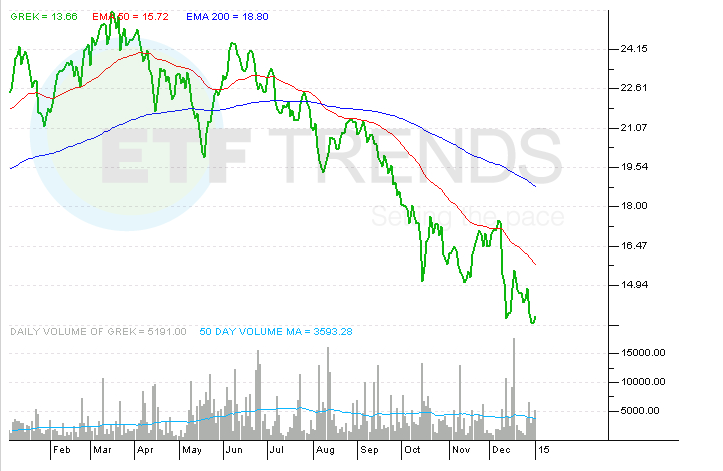
The Global X FTSE Greece 20 ETF (NYSEArca: GREK) is down 18.7% over the past month and lost 40%, or two official bear markets, last year. Prolonged weakness in the lone Greece ETF could be a sign markets are again bracing for the possibility of the country’s from the European Monetary Union.
Just two years after Greece brought the Eurozone to the brink of a full-fledged crisis and stoked speculation that the common currency scheme was close to meeting its demise, Greece’s fractured political system has onlookers mulling the possibility of a Eurozone without the country.
Greeks head to the polls on Jan. 25 with a new candidate to consider. Last Friday, former Prime Minister George Papandreou, the man many blame for the escalation of the Greek debt crisis in 2011, announced the creation of a third political party, though he and his Movement for Change party are not seen as credible threats to frontrunners, the New Democracy and Syriza parties.
Further hampering the near-term outlook for GREK and Greek stocks are diverging views on Greece’s financial position, one that includes 10-year bond yields hovering near 9.3%, up from just under 8.1% on Dec. 9. [More Greek Drama; ETF Slides]
“According to the budget, Greece will achieve a primary budget surplus—before taking into account debt payments—of €3.3 billion ($4.1 billion), equal to 3% of gross domestic product, next year, which is in line with the country’s bailout program. Overall, the government will record only a minor budget deficit of €338 million—equivalent to just 0.2% of gross domestic product—next year, in effect marking the first balanced budget Greece has produced in four decades,” according to the Wall Street Journal.
However, as Mish’s Global Economic Trend Analysis points out, Bank of America Merrill America Lynch sees Greece facing a budget gap of 28 billion euros over years with 17 billion euros worth of repayments due in the first year.
While a silver lining for GREK may be difficult to find at the moment, the good news is the current drama playing out for Greek stocks may not be a sequel to the past contagion that roiled equity markets throughout the Eurozone and the world. Remember that Greece is now classified as an emerging market, arguably limiting comparisons to developed Eurozone nations. http://www.etftrends.com/2013/10/and-that-makes-three-greece-gets-another-market-demotion/
German officials believe the Eurozone can survive without Greece. Over the past month, Recon Capital DAX Germany ETF (NasdaqGM: DAX), a tracking ETF for Germany’s benchmark DAX index, is off 3.6%, a fraction of GREK’s loss over the same period.
“The concern that a Greek crisis poses systemic risk of the euro area as a whole has lessened. Spain and Ireland, for example, are on the mend,” according to Marc to Market, which also notes Italy last week sold 10-year bonds at record low interest rates. The iShares MSCI Italy Capped ETF (NYSEArca: EWI) is off 7.5% over the past month.
Global X FTSE Greece 20 ETF