Income investors know a dividend is nice, but a consistently growing payout is even better. Hence, the popularity of the S&P Dividend Aristocrats indexes and the exchange traded funds that track those benchmarks.
To qualify for admission to either the S&P Dividend Aristocrats Index or the S&P High Yield Dividend Aristocrats Index, companies must have minimum dividend increase streaks of at least 20 or 25 years and yes, Standard & Poor’s does remove companies that fail to keep those streaks alive.
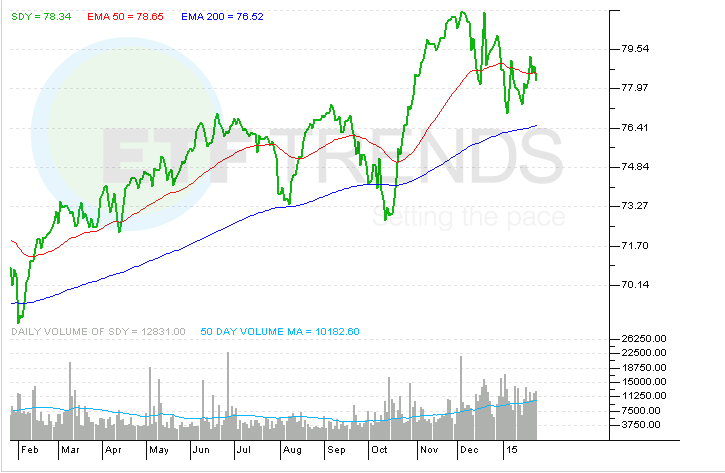
With that in mind, the SPDR S&P Dividend ETF (NYSEArca: SDY), which is benchmarked to the S&P High Yield Dividend Aristocrats Index, is about to make some changes. SDY’s underlying index mandates constituent firms have a minimum dividend increase streak of 20 years for inclusion.
At the close U.S. markets Friday, the S&P High Yield Dividend Aristocrats Index will part ways with Diebold (NYSE: DBD), Energen (NYSE: EGN) and Family Dollar (NYSE: FDO) while welcoming Albemarle (NYSE: ALB), CDK Global (NYSE: CDK), Essex Property (NYSE: ESS) Expeditors International (NasdaqGS: EXPD), Mercury General (NYSE: MCY), Realty Income (NYSE: O) and Ross Stores (NasdaqGS: ROST).
Five of those stocks have dividend increase streaks of 20 years while Mercury General and CDK have payout increase streaks of 28 and 40 years, respectively, according to S&P Dow Jones Indices. Three of SDY’s new additions are financial services firms. The sector is already the ETF’s largest at a weight of 21.5%. Financial services and consumer discretionary are the only two sectors expected to deliver double-digit dividend growth this year. [Dividend Growth Buoys Dividend ETFs]
Home to almost $14 billion in assets under management, SDY is one of the largest U.S. dividend ETFS. The ETF has a trailing 12-month yield of 2.26%.
The S&P 500 Dividend Aristocrats Index, which only includes companies that have increased their dividends for at least 25 consecutive years, serves as the benchmark for the increasingly popular ProShares S&P 500 Aristocrats ETF (NYSEArca: NOBL). At the close Friday, that index will part ways with Family Dollar. No new additions are being made to the index at this time, according to S&P Dow Jones Indices.
With NOBL’s scant utilities sector exposure (just 1.86% at the end of the third quarter), the ETF should continue acquiring new assets if interest rates rise this year. After coming to market in October 2013, NOBL has rapidly managed to top $500 million in assets under management. [Dividend ETF Draws Praise]
What makes NOBL an alluring option among dividend ETFs is that even though the ETF is home to plenty of mature, old line companies, as evidenced by the 25-year dividend increase streak requirement, the ETF sports a yield of less than 2%. That implies ample room for dividend growth by the ETF’s roughly 50 holdings.
The importance of dividend growth as a driver of a portfolio’s total returns cannot be understated. From 1972 through 2012 companies that initiated or consistently raised dividends outperformed and were less volatile than the companies either did not pay, cut or kept dividends stagnant, according to Ned Davis Research.
Since the start of 2015, 18 companies have boosted dividends while one has announced a reduced or suspended payout, according to S&P.
SPDR S&P Dividend ETF