Many investors have utilized passive index-based exchange traded funds to garner broad long-term positions. Nevertheless, traders can also use different types of relative strength and tactical rotation strategies to capture short-term opportunities and improve an ETF portfolio’s performance.
On the recent webcast, Getting Active with ETFs, Tom Dorsey, founder of Dorsey Wright & Associates, explains how stocks, sectors and asset classes can move in and out of favor. Consequently, investors can track relative strength indicators to jump on markets gaining momentum and try to ditch those that are becoming overcrowded.
“Stocks with the best momentum outperformed those with the worst momentum, both in absolute terms and relative to the entire equity market,” Dorsey said.
Using the relative strength index, investors can identify areas with positive forward momentum. Relative strength essentially measures a stock’s performance in relation to its peers.
“Relative strength is a means for identifying market leadership,” Dorsey added.
With more financial advisors seeking a way to adapt to shifting conditions, many may use relative strength as another tool in their investment tool kit. According to a recent ETF Trends and RIA Database survey, the majority of Financial Advisors do implement some sort of tactical, short-term strategy.
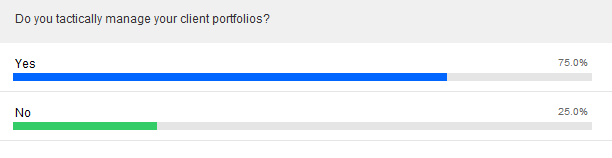
Additionally, as market conditions change, investors can also rotate strategies to potentially maximize portfolio returns. We are now more likely to enter a period of steady market conditions after the strong bull rally. Consequently, ETF investors may consider a covered call strategy for the conditions ahead.
For instance, the Horizons S&P 500 Covered Call ETF (NYSEArca: HSPX) uses covered calls with S&P 500 securities, and the Horizons Financial Select Sector Covered Call ETF (NYSEArca: HFIN) tracks the S&P Financial Select Sector Covered Call Index.
Joseph Cunningham, executive VP and head of capital markets at Horizons ETFs, points out that these type of covered call strategies can potentially outperform buy-and-hold, long equity positions during bearish, rangebound and slow bullish market environments. Additionally, the strategy may outperform during periods of volatility.
“Covered call premiums historically rise during rising volatility,” Cunningham said. “As a result, a covered call strategy may potentially harvest more option premium during a market with rising volatility.”
However, potential investors should be aware that the covered call strategies can lag during strong bull rallies.
Looking at the relative strength of the covered call ETFs, HSPX currently shows a 60.8 reading with a 14-day look-back period – readings above 70 are typically considered overbought while readings below 30 reflect oversold conditions. HFIN, though, has a RSI of 76.5, according to StockCharts.
Horizons S&P 500 Covered Call ETF

Financial advisors who are interested in learning more about implementing passive ETF strategies can listen to the webcast here on demand.