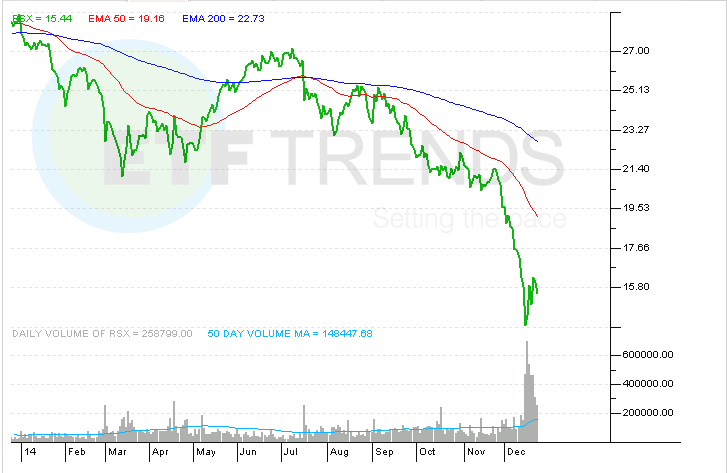
Exchange traded funds holding Russian equities will end 2014 the same way they started the year: In topsy turvy fashion.
Last week, ETFs such as the Market Vectors Russia ETF (NYSEArca: RSX), jumped after Russia’s Central bank boosted its benchmark interest rate to 17% from 10.5%. The rate hike was the second since in a week and in the span of less than a week Russian borrowing costs have more than doubled from 8%.
By the end of last week, some options traders were betting on gains for RSX with RSX’s call-to-put ratio reaching its highest levels of the month. That bullish activity was seen as a sign that RSX, a notoriously volatile ETF, was set for calmer days ahead. [Options Traders Turn Bullish on Russia ETFs]
The options market quickly changed its on mind on RSX.
“Taking a quick step back, puts traded at 1.3 times the average daily pace on Monday. The vast majority of the day’s action centered on RSX’s January 2015 11-strike put, where two large blocks totaling 30,150 contracts were bought to open for $753,750 (number of contracts * $0.25 premium paid * 100 shares per contract),” reports Karee Venema for Schaeffer’s Options Center.
Importantly, the trader or traders behind those trades paid up to establish a bearish position on RSX as the ETF’s “30-day at-the-money implied volatility close at 67.2% Monday — in the 99th annual percentile — but its Schaeffer’s Volatility Index (SVI) of 67% rests higher than 88% of similar readings taken in the past year. Simply stated, premium on RSX’s front-month options is relatively expensive at the moment,” according to Schaeffer’s.
Perhaps it was just a mere coincidence, but Monday’s bearish options action in RSX came a day before the ETF fell 3.4% on more than double the average daily volume after Standard & Poor’s placed Russia’s sovereign debt on CreditWatch with negative implications, indicating Russia could lost its already tenuous grasp on its investment-grade credit rating. [Russia Flirts With Junk Credit Rating]
S&P’s move to put Russia on CreditWatch negative reflects the ratings agency’s “view that there is at least a one-in-two likelihood of a negative rating action within 90 days,” according to S&P.
Market Vectors Russia ETF