Dividend exchange traded funds enjoyed another strong showing in 2014. Over $10 billion of inflows, helping make dividend ETFs primary drivers of the smart beta boom, confirm as much.
However, the leaders among dividend ETFs this year are those with large utilities sector allocations. That makes sense because utilities are currently tussling with health care stocks for top honors among the 10 S&P 500 sectors this year. [Utilities Boost These Dividend ETFs]
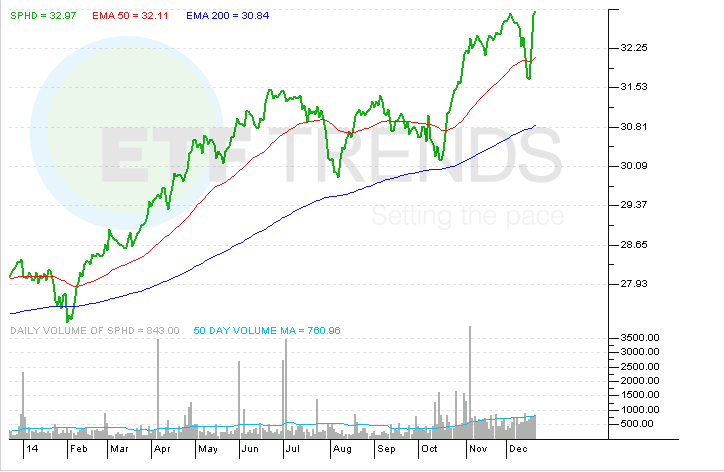
The PowerShares S&P 500 High Dividend Portfolio (NYSEArca: SPHD) is one dividend ETF that has gotten a lift from the utilities sector’s sturdiness this year. With a 19.5% weight to utilities, its largest sector weight by 92 basis points over consumer staples, has climbed nearly 17% and hit an all-time high on almost double its average daily volume on Monday.
SPHD’s overweight to the utilities sector has clearly made a difference in terms of return. Up 16.8% this year to be precise, the ETF has outpaced the S&P 500 by 435 basis points. Additionally, SPHD has easily topped the 10.3% average return for the Vanguard Dividend Appreciation ETF (NYSEArca: VIG) and the Vanguard High Dividend Yield ETF (NYSEArca: VYM), two of the largest U.S. dividend ETFs. VIG and VYM have utilities weights of just 1% and 7.7%, respectively.
SPHD tracks the S&P 500 Low Volatility High Dividend Index, which is comprised of 50 stocks taken from the S&P 500 that have historically exhibited high dividend yields and low volatility. [The Right Dividend ETF for the Times]
“On inspection, the methodology of SPHD indeed fits the bill of a ‘high dividend’ index. There are no filters on ‘quality,’ though restricting the universe to S&P500 stocks ensures that only well-known companies form part of the index. Moreover, there is no filter for dividend growth,” notes Stanford Chemist on Seeking Alpha.
While SPHD lacks an official dividend growth screen, it is worth noting that several members of the ETF’s 50-stock lineup, including AT&T (NYSE: T) and Sysco (NYSE: SYY), are also members of the S&P Yield Dividend Aristocrats Index, which mandates 25 years of dividend hikes for entry. [An ETF for Late Year Dividend Hikes]
Importantly, SPHD’s 2014 dividend topped what the ETF paid last year. “The total dividends paid in 2014 is $1.082, which is 3.7% increase compared to dividends paid in 2013 ($1.043),” according to Stanford Chemist.
A trailing 12-month yield of 3.23% is 107 basis points above where 10-year Treasury yields closed Monday, but if there is a rub with SPHD it is, not surprisingly, the ETF’s defensive posture makes it look pricy relative to other dividend ETFs with smaller combined weights to the expensive consumer staples and utilities sectors. For example, SPHD’s P/E ratio of 20.4 is about 10% higher than VIG’s, according to Seeking Alpha.
Still, investors have embraced SPHD as evidenced by the ETF’s 2014 inflows of $86.4 million or nearly a third of the $255.7 million currently held by the fund. As an added bonus, SPHD pays a monthly dividend, a feature not found on many rival dividend ETFs.
PowerShares S&P500 High Dividend Portfolio
Todd Shriber owns shares of SPHD.