Exchange traded funds that track real estate investment trusts are rising to new highs as yields on government bonds continue to fall, pushing investors to alternative avenues of income.
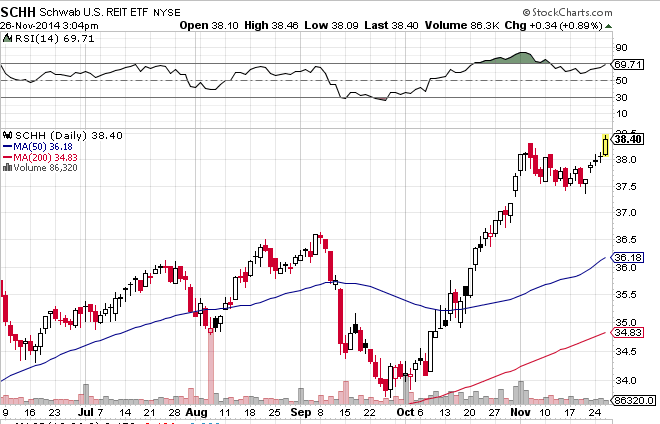
For instance, the Schwab US REIT ETF (NYSEArca: SCHH) was up 0.9% and touched a new intraday high Wednesday. The ETF is up 4.0% over the past month and 28.0% higher year-to-date. [Real Estate Is Having a Moment]
SCHH currently shows a 2.32% 12-month yield.
REITs’ higher yields are a result of their legal structure. To qualify for a REIT status, the real estate company has to pay out 90% of its taxable income to shareholders as dividends.
With benchmark 10-year Treasury yields falling to 2.24% from around 3.0% at the start of the year, more investors have sought out alternative assets to satisfy their income targets.
Some may argue that rising interest rates ahead would pose a threat to the REITs space. Since REITs use debt to finance growth, rising rates would mean more expensive debt servicing and less dividends to payout to investors.
Nevertheless, many investors and registered investment advisors are looking into the REITs asset class as a decent investment for a rising rate environment. [Sector Classification Change Could Boost REITs ETFs]
“I looked at a lot of research and found that in periods where rates rise, REITs will all almost overwhelmingly do as well as, or even better than, stocks until they get to a certain point,” JJ Feldman, portfolio manager at Miracle Mile Advisors, said in an Institutional Investor article. “That point could be three years away.”
For instance, according to Cohen & Steers, historical data has shown that REITs can generate attractive returns in a rising rate environment.
“REITs have generated an average annual return of 11.4% over the six monetary tightening cycles that have occurred since 1979,” Cohen & Steers said. “Over the seven periods in this time frame when U.S. Treasury yields were rising, REITs generated an average annual return of 14.9%.”
Moreover, once prices picks up, REITs can also be used as an effective hedge against inflation. The asset class also shows low correlation to traditional assets. Consequently, more RIAs and investors may be looking at REITs as an attractive investment to diminish exposure to the broad equity moves. [Real Asset ETF Options with Smart Money Already Hedging Inflation]
Schwab US REIT ETF
For more information on the real estate investment trusts, visit our REITs category.
Max Chen contributed to this article.