Retail investors can gain exposure to targeted areas of the market like the nuclear energy and uranium industry. Nevertheless, traders should not be too overzealous with their allocations as the sector has exhibited extreme bouts of volatility.
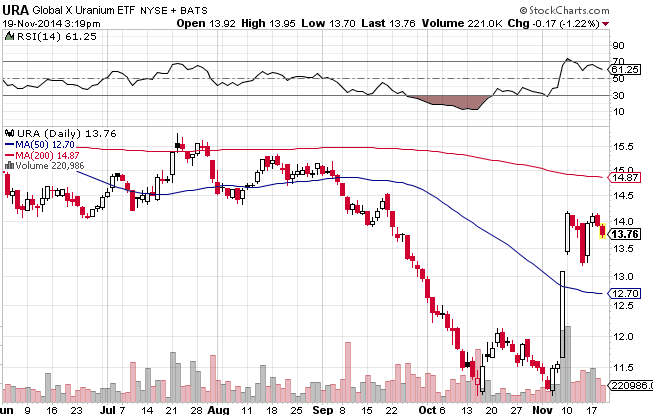
The Global X Uranium ETF (NYSEArca: URA), which tracks uranium miners, has declined 81% since it began trading in 2010, reports Eric Balchunas for Bloomberg. Over the past three years, URA has generated an average annualized return of negative 19.1%.
The uranium ETF came to market a few months before Japan’s March 2011 Fukushima nuclear disaster, which forced Japan to shutdown all of its nuclear reactors in light of new safety concerns.
Consequently, uranium supply has been outstripping demand. Additionally, the cheap crude oil prices have not helped the outlook for nuclear energy as an alternative source of energy.
In the past month, though, URA has surged 19.3%, showing renewed signs of life as Japan plans to restart its nuclear reactors, with some plants slated to begin running by next year. [Uranium ETF Recharges as Japan Opens Nuclear Plants]
Further supporting gains in the uranium industry, China has also planned to quadruple its nuclear capacity by 2020 in an effort to diminish harmful greenhouse gases.
The changing demand outlook from nuclear plants has helped propel uranium prices from $28 per pound over the summer to $44 last week, reports Peter Koven for Financial Post.
“Things are moving in the right direction. But it’s still very early stage, so I think there’s quite a bit further to go,” Robert Gill, a portfolio manager at Lincluden Investment Management, said in the Financial Post article.
Uranium prices still remain below the marginal cost of production, which industry experts calculate at around $65 to $70 per pound.
However, supply could be a issue in the mid-term. Industry observers believe demand could outstrip supply by around 2017. According to the World Nuclear Association, there are 71 new reactors under construction worldwide, with 27 in China. Additionally, the U.S.-Russia nuclear disarmament agreement has come to an end, removing another source of uranium supply from the market.
Global X Uranium ETF
For more information on the uranium industry, visit our uranium category.
Max Chen contributed to this article.