Another year of low interest rates has, once again, sent investors flocking to dividend exchange traded funds. With this year’s 22.4% drop for 10-year Treasury yields, several of the top-performing and best asset-gathering dividend ETFs are those funds heavy on utilities stocks.
Utilities’ status as the S&P 500’s best sector has put the spotlight on dividend ETFs, such as the iShares Select Dividend ETF (NYSEArca: DVY) and the First Trust Morningstar Dividend Leaders Index Fund (NYSEArca: FDL), that have significant weights to that sector, but the ongoing ascent of the technology sector as a credible dividend outlet is helping power other dividend ETFs. [Utilities Power These Dividend ETFs]
“Utilities and consumer staples are the two most overweight sectors within equity income ETFs, with average allocations 8.1 and 7.0 percentage points higher than the S&P 500 Index, respectively,” said First Trust Senior Vice President and ETF Strategist Ryan Issakainen in a recent research note.
Many dividend ETFs sacrifice exposure to future sources of dividend growth, such as the technology sector, in favor of sectors’ past dividend track records. Hence, the often substantial overweights to staples and utilities and relatively thin exposure to tech in equity income funds.
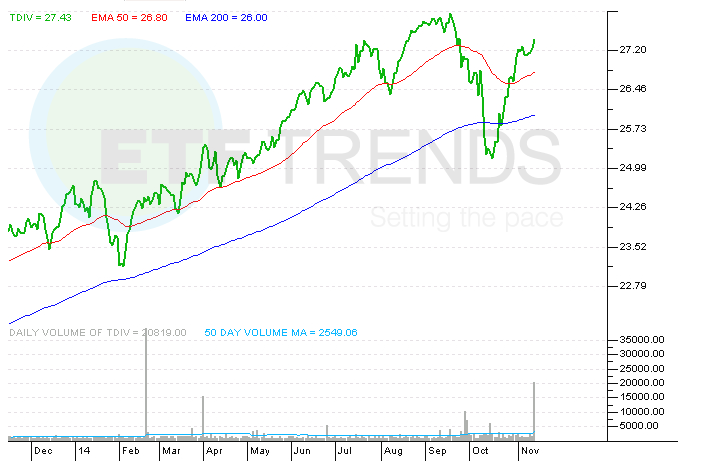
The ascent of tech dividends has created a captive audience for ETFs like the First Trust NASDAQ Technology Dividend Index Fund (NasdaqGS: TDIV). TDIV has soared in popularity as the technology has progressively become a more legitimate and attractive dividend destination over the past several years. TDIV has added $406.1 million of its $744.4 million in assets under management this year.
While the concept of dividend growth in the tech sector is still relatively new, that does not mean it will not prove rewarding for investors. The sector is one of largest contributors to S&P 500 dividend growth over the past few years. [A Tech ETF for Your Grandparents]
“An equally important consideration for equity income ETFs is which sectors are underweight. As of 9/30/14, technology was the most underweight sector within equity income ETFs, with a 10.1 percentage point lower asset-weighted average allocation than the S&P 500 Index. This is especially notable because the information technology sector’s dividend growth rate has exceeded all other sectors over the past 3, 5, and 10 years and the sector currently pays more dividends than any other sector in the S&P 500 Index,” according to Issakainen.
The average payout increase from Apple, IBM (NYSE: IBM), Cisco (NasdaqGS: CSCO) and Qualcomm (NasdaqGS: QCOM) this year is almost 14%. Those stocks combine for nearly 28% of TDIV’s weight.
Interestingly, “roughly half the dividend-paying technology stocks in the S&P 500 offer higher dividend yields than that of the S&P 500 Index,” notes Issakainen.
TDIV tracks the NASDAQ Technology Dividend Index, which has a dividend yield of 2.82. That is well above what investors normally expect of the tech sector and that yield comes by virtue of a mandate that states the index hold at least 20% of its weight in telecom stocks
TDIV’s yield is not excessive, implying room for dividend growth and safety of current payouts because the largest U.S. tech firms also have some of the largest cash hoards and do not have high payout ratios. [Dividend ETFs With Safe Dividends]
The “technology sector had a 6.5% free cash flow yield and a 5.2% earnings yield, both significantly higher than the sector’s 1.5% dividend yield. This spread between dividends compared to free cash flows and earnings suggests that technology companies may have more room to organically support longer term dividend increases, rather than simply distributing excess cash retained over the past several years,” said Issakainen.
First Trust NASDAQ Technology Dividend Index Fund
Tom Lydon’s clients own shares of Apple and DVY.