Despite declining to five-year lows, oil-related exchange traded funds keep attracting asset inflows as investors try to catch a falling knife.
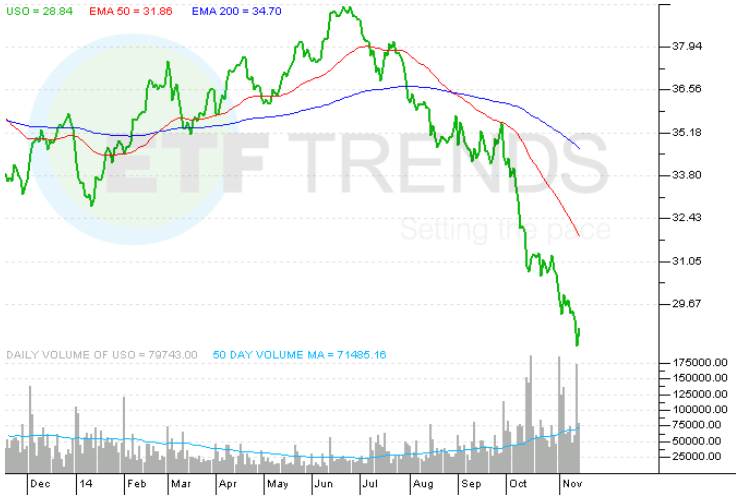
The United States Oil Fund (NYSEArca: USO), which tracks West Texas Intermediate oil, decreased 18.4% year-to-date, trading near its lowest level since March 2009.
Meanwhile, the United States Brent Oil Fund (NYSEArca: BNO) declined 29.6% year-to-date and is now hovering near its lowest since January 2011.
As oil prices continue to fall lower, investors are increasing their bets for a positive turnaround. For the week ended November 14, USO added $209.1 million in assets under management while BNO saw $1.5 million in net inflows, according to ETF.com data. [Good Money After Bad: Oil ETFs are Raking in Cash]
Additionally, over the past week, the ProShares Ultra Bloomberg Crude Oil (NYSEArca: UCO), which takes the two times or 200% daily performance of WTI crude oil, attracted $60.3 million in assets while the VelocityShares 3x Long Crude ETN (NYSEArca: UWTI), which tracks three times or 300% the daily performance of WTI crude, brought in $10.0 million in assets.
Year-to-date, UCO has plunged 34.0% and UWTI plummeted 50.5%.
Speculators are turning more bullish on oil for the first time in three weeks, with net-long positions on WTI up 8.7% in the week ended Nov. 11, betting that the Organization of Petroleum Exporting Countries will be forced to counter the quickly falling oil prices, reports Mark Shenk for Bloomberg.
Moreover, hedge funds and other financial traders raised bullish bets on Brent crude to their highest in two months over the past week, with net wagers on rising prices up 17% to 66,636 contracts for the week ended Nov. 11, reports Grant Smith for Bloomberg.
“This must have caused money managers some pain,” Ole Sloth Hansen, an analyst at Saxo Bank A/S, said in the article. “Calling the bottom of the market is one thing, but actually finding it is something else.”
WTI crude oil futures were trading around $75.5 per barrel Monday while Brent crude oil futures were hovering around $79.1 per barrel.
Oil prices has been falling as U.S. output reached a three-decade high, which exacerbated the global glut, and demand dipped due to a slowing global economy. [Oil ETFs Languish Under Extended Bearish Outlook]
“The market is under incredible pressure and it will stay that way until OPEC takes decisive action,” Rob Haworth, a senior investment strategist at U.S. Bank Wealth Management, said in the article.. “There has to be something that changes the story, which is that there’s too much supply.”
United States Oil Fund
For more information on the oil market, visit our oil category.
Max Chen contributed to this article.