Hopes for a post-Thanksgiving rally for downtrodden oil exchange traded funds were vanquished during the American holiday when the Organization of Petroleum Exporting Countries (OPEC) opted to keep its daily output unchanged at 30 million barrels.
The 12-member cartel made the decision at its Vienna meeting Thursday and the headlines sent oil futures tumbling. West Texas Intermediate futures fell below $70 per barrel for the first time in over four years.
During Thursday’s Asian session, WTI futures for January 2015 delivery slid $5.14, or 6.98%, to $68.55 per barrel.
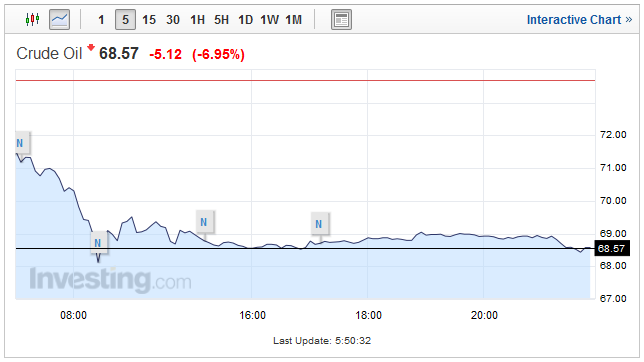
Chart Courtesy: Investing.com
OPEC’s decision to not support slumping oil prices is likely to further pressure an array of oil ETFs that are already mired in bear markets. “Analysts had estimated OPEC would need to take 1 million to 1.5 million barrels a day off the market to support oil prices, which have fallen by more than 30% since the summer,” according to the Wall Street Journal.
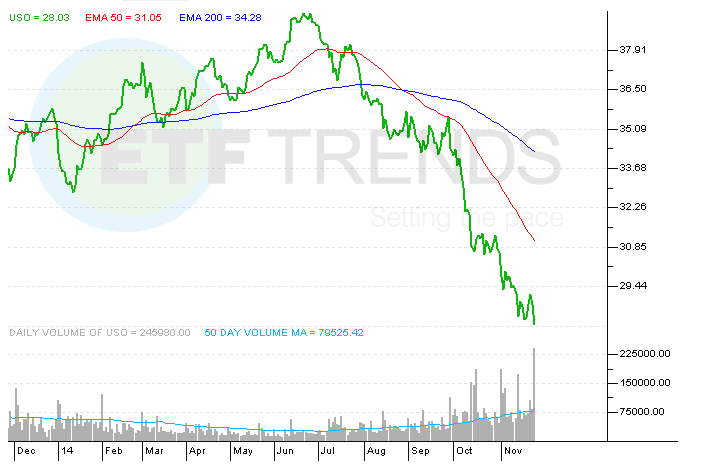
The United States Oil Fund (NYSEArca: USO) hit a new 52-week low Wednesday and is off 20.3% over the past 90 days, putting the ETF officially in bear market territory. Making USO’s Wednesday decline all the more ominous is that it happened on more than double the average daily volume on the day before Thanksgiving, a day typically known for its light volume. [Getting it Wrong With Oil ETFs]
Despite crude’s struggles, futures-based oil ETFs have recently been prolific asset gatherers. With inflows of over $445 million just this month, USO recently became a $1 billion ETF. Over the past month, the PowerShares DB Oil Fund (NYSEArca: DBO) has added $41.7 million in new assets, or 15% of its assets under management, a total surpassed by just 11 PowerShares over that period, according to issuer data.
Investors also have not been shy about taking on leverage with oil ETFs as highlighted by nearly $122 million of November inflows to the ProShares Ultra Bloomberg Crude Oil (NYSEArca: UCO). UCO had less than $180 million in assets under management at the end of the third quarter. [Cash Keeps Flowing to Oil ETFs]
However, it pays to remember that growth in USO’s assets and shares outstanding counts is also the result of some traders getting it right and shorting the ETF. One way of looking at that scenario is that even if oil prices keep tumbling it would be reasonable to expect USO to get bigger with a significant portion of that growth fueled by short sellers.
That strategy is likely to be rewarded today.
United States Oil Fund