The Standard & Poor’s Investment Advisory Services (SPIAS) Portfolio Strategy Committee revealed the latest update to its Capital Appreciation Model Allocation Portfolios (MAPs), showing an overweight posture on exchange traded funds with exposure to U.S. equities.
Standard & Poor’s Investment Advisory Services’ portfolio strategy committee combines fundamental analysis with the Black-Litterman model, a mean-variance tool, in constructing its Capital Appreciation Model Allocation Portfolio (MAP). As S&P Capital IQ highlights in a new research note, the quantitative effort is run through a portfolio optimizer while the portfolio’s qualitative screen is reviewed quarterly to consider allocation changes within a 12-month investment horizon. [Asset Allocation With ETFs]
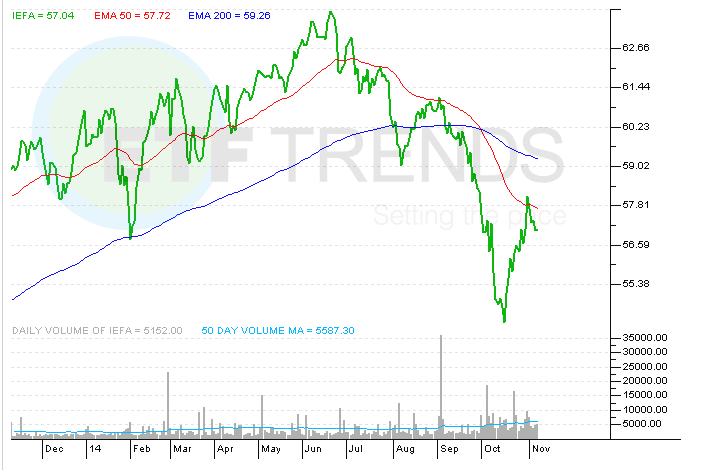
One of the ETFs recently added to MAPs is the well-known Vanguard REIT ETF (NYSEArca: VNQ). VNQ, the largest REIT ETF, was added as S&P reduced exposure to the iShares Core MSCI EAFE ETF (NYSEArca: IEFA) “amid concerns about slower growth in the Eurozone and Japan.”
Like rival REIT ETFs, VNQ has benefited from tumbling Treasury yields this year. A 3.2% trailing 12-month yield, which is 84 basis points above 10-year Treasury yields, has motivated investors to pour over $4.3 billion in new assets into VNQ. On a year-to-date basis, only six ETFs have added more new capital. [REITs for Diversity and Income]
VNQ includes diversified REITs 10.6%, health care REITs 13.3%, hotel & resort REITs 8.0%, industrial REITs 4.5%, office REITs 13.3%, residential REITs 16.3%, retail REITs 25.9% and specialized REITs 8.1%.
“There are six risk profiles in the Capital Appreciation MAP, with the most conservative risk profile (Conservative) targeting approximately 40% equity/60% fixed income allocations and the most aggressive risk profile (Enhanced Growth) targeting a 90% equity/10% fixed income split,” said S&P.
S&P also boosted exposure to the iShares S&P 500 Value ETF (NYSEArca: IVE) while reducing its allocation to the iShares Core S&P Mid-Cap ETF (NYSEArca: IJH). S&P Capital IQ rates IVE overweight. [Vindicated Value ETFs]
IVE, which has added $1.3 billion in new assets this year, cements its value credentials with a combined 38% allocation to the financial services and energy sectors, two groups that currently trade at discounts to the S&P 500.
MAPs fixed income exposure includes an allocation to the Vanguard Short-Term Bond ETF (NYSEArca: BSV). The strategy favors BSV because the ETF has a low duration, making it less sensitive to interest rate changes. BSV’s annual fee of just 0.1% make it less expensive than 88.5% of rival funds.
The strategy’s international allocations include the aforementioned IEFA and the iShares Core MSCI Emerging Markets ETF (NYSEArca: IEMG), which replaced the Vanguard FTSE Emerging Markets ETF (NYSEArca: VWO) and the iShares MSCI EAFE ETF (NYSEArca: EFA) last year.
IEFA charges just 0.14% per year compared to 0.33% on EFA while IEMG helps the S&P strategy maintain exposure to South Korea, a trait not featured in VWO.
iShares Core MSCI EAFE ETF
Tom Lydon’s clients own shares of EFA.