Imagine a bong market currently valued at approximately $4.5 trillion, home to an AA- credit rating from Standard & Poor’s and 10-year yields of 3.66%, or more than 130 basis points above the comparable U.S. Treasuries.
There is no need to strain the imagination because such a market exists and it is one scores of investors are already familiar with: China. While many investors are somewhat familiar with Chinese equities, the hard-to-access onshore bond market is often left out of the global fixed income conversation. As such, many portfolios are woefully under-allocated to the world’s third-largest bond market or, worse yet, feature no exposure at all to Chinese debt.
A wave of new exchange traded funds are looking to change that scenario. The Market Vectors ChinaAMC China Bond ETF (NYSEArca: CBON) debuted last week, giving it claim to being the first U.S.-listed ETF offering investors access to China’s onshore bond market. CBON’s launch was followed by the Tuesday debut of the Global X GF China Bond ETF (NYSEArca: CHNB). [China Bond ETF Race Heats Up]
KraneShares, the ETF issuer behind the popular KraneShares CSI China Internet Fund (NasdaqGM: KWEB), is reportedly moving towards the launch of the KraneShares E Fund China Commercial Paper ETF. That ETF tracks an index with a solid 4.6% yield.
The timing of the new China bond ETF launches appears fortuitous. CBON debuted just days before the launch of the Shanghai-Hong Kong Stock Connect while CHNB followed just a day after the Stock Connect launch.
The Stock Connect program is also part of China’s efforts to further liberalize its sprawling financial markets to foreign investors. China’s efforts to open its financial markets to attract more foreign investment also include increased access to the yuan, which in turn could lead to the inclusion of Chinese onshore bonds in major global indices, according to CNBC.
Such a promotion is not imminent, but there some major buyers are already eyeing increased allocations to Chinese debt. That could prove to be an important catalyst for CBON, CHNB and the KraneShares E Fund China Commercial Paper ETF when it lists.
“The most conservative investors in the world — the central banks — are saying they’re going to put anywhere from 5-25 percent of their foreign exchange reserves into Chinese government bonds,” Hayden Briscoe, director of Asia-Pacific fixed income at AllianceBernstein told CNBC.
CHNB allocates 45% of its weight to bonds issued by state-owned enterprises, 32% to policy bank notes and 23% to government debt. S&P mandates that issues from central state-owned enterprises included in CHNB’s index carry an AAA rating from at least one of China’s major ratings agencies.
“China’s domestic bond market is expanding and evolving at the same time. While the full liberalization of the markets is likely to take a long time, movement towards greater access for borrowers and lenders, and a higher degree of market oriented financings such as bond issuance have already greatly broadened the opportunity set for local investors,” said Fran Rodilosso, senior investment officer for Market Vectors ETFs, in a statement. [Van Eck Launches First China Onshore Bond ETF]
Not only is China the world’s third-largest bond market, but its $1.5 trillion corporate bond market is the world’s largest. Chinese companies are expected to absorb a third of global corporate debt needs over the next five years, indicating there could be a robust appetite for ETFs offering exposure to the country’s local commercial paper.
ETFs such as CBON and CHNB could also be favored by global investors not only because of attractive yields, but also because China’s bonds have historically shown low correlations to other fixed income assets.
CBON Holdings
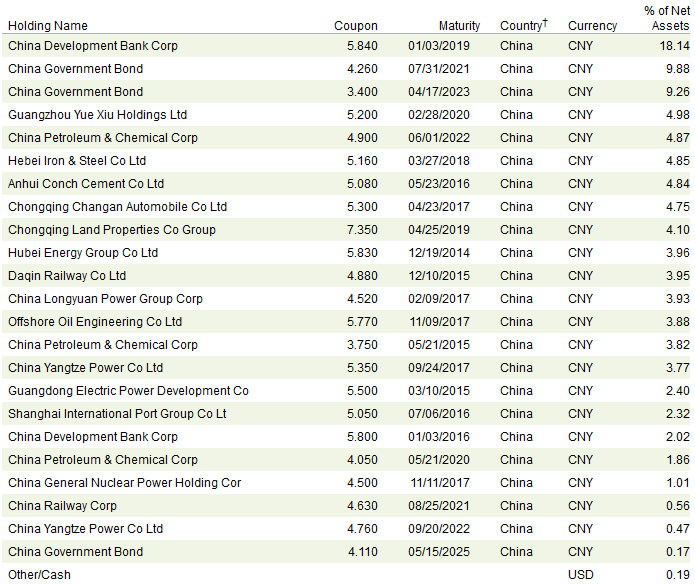
Table Courtesy: Van Eck Global/Market Vectors