With diverging central bank policies and major shifts in the the foreign exchange market underway, Japaneses equity investors should consider a yen-hedged exchange traded fund to access an expanding economy while limiting any Forex risks associated with overseas investments.
On the recent webcast, Is Your Japan ETF Positioned to Benefit from Japan’s Recent Shift?, Dan Brehon, Director of FX Strategy at Deutsche Bank, outlines the changing trends behind the U.S. dollar and Japanese yen currency trade.
“The dollar is starting a broad uptrend,” Brehon said.
The greenback has oscillated between periods of strength and weakness. Currently, the USD is finally showing some color after going through a nine year downtrend that ended mid-2011. The dollar has appreciated as the Federal Reserve ended its quantitative easing program, and traders are fueling the trade in anticipation of a rate hike ahead.
In contrast, on the other end of the currency trade, the Bank of Japan is implementing aggressive easing policies to stimulate a stagnant economy. Moreover, Japan’s Government Pension Investment Fund (GPIF), the world’s largest pension fund, is expected to diversify its holdings by raising its foreign asset exposure. Both actions will continue to weigh on the Japanese yen and have already pushed the U.S. dollar to a seven-year high against the yen currency. [Japan ETFs Find Double Support From BOJ, Pension Fund]
In the equities market, Ron Saba, Senior Managing Director of Investment Management at Horizon Investments, pointing to compelling historical valuations compared to the U.S., arguing that Japanese stocks have grown cheaper relative to U.S. assets. According to a recent ETF Trends and RIA Database survey, advisors are growing more optimistic about Japan’s outlook.
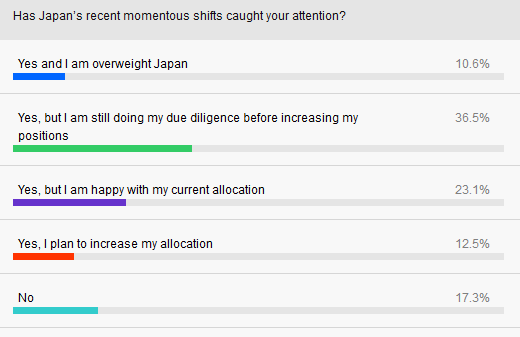
Investors still seeking a way to access the relatively cheaper Japanese equities market may be better served with a currency-hedged stock ETF, like the Deutsche X-trackers MSCI Japan Hedged Equity ETF (NYSEArca: DBJP). DBJP shows a 14.7 price-to-earnings ratio and a 1.1 price-to-book, compared to the S&P 500 Index’s 17.6 P/E and 2.5 P/B.
“A hedged japan is the preferred exposure given policy dynamics,” Saba said.
Lance Allen, ETF Regional Vice President at Deutsche Asset & Wealth management, explains that DBJP tries to reflect the performance of the MSCI Japan U.S. Dollar Hedged Index. The index mitigates the exposure to fluctuations between the value of the U.S. dollar and Japanese yen, which could allow the hedged fund to outperform a non-hedged if the yen continues to depreciate against the dollar.
Financial advisors who are interested in learning more about a Japanese hedged-equity strategy can listen to the webcast here on demand.