In news that is far from surprising, the PIMCO Total Return ETF (NYSEArca: BOND) is losing assets in the wake of Bill Gross’ departure, announced last week, from PIMCO, the California-based bond manager he co-founded.
BOND, the actively managed ETF formerly managed by Gross and the ETF version of the storied Total Return mutual fund, had close to $3.7 billion in assets under management on Sept. 24. That was a day after the Wall Street Journal reported the SEC is probing PIMCO regarding pricing issues at BOND that potentially could have inflated returns advertised to prospective investors. However, the Journal also acknowledged “It isn’t clear any of the actions by Pimco that are being examined are improper. It can be difficult to ascertain proper valuations in the debt markets, especially for bonds that are relatively small in dollar terms or don’t trade frequently” and two days prior to Gross’ stunning resignation announcement. [PIMCO ETF Contends With SEC Probe]
BOND’s assets under management tally was just over $3 billion as of the close of U.S. markets on Sept. 30, according to PIMCO data.
Beneficiaries of asset flight from PIMCO, both at the a company and ETF-specific level, had previously been identified and it is now becoming clear where some investors that are departing BOND are heading.
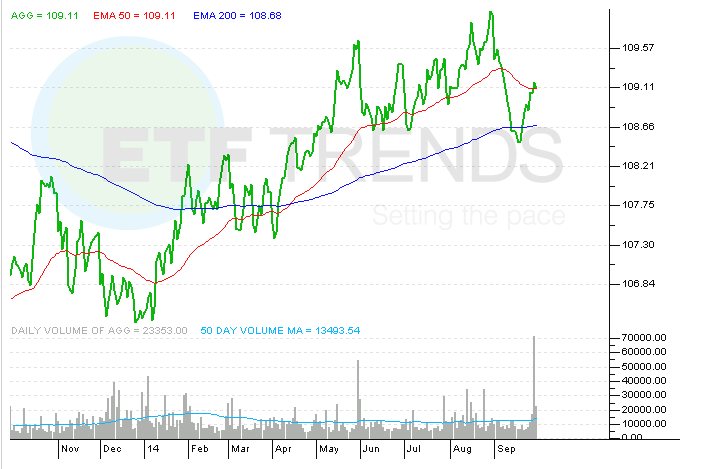
The iShares Core U.S. Aggregate Bond ETF (NYSEArca: AGG), a passively managed rival to BOND, added $773.5 million in new assets from Sept. 26 through Sept. 30. “On Monday, trading volume in the ETF surged to $791 million, an all-time record, according to BlackRock,” reports Chris Dieterich for the Wall Street Journal.
The $18.8 billion AGG is part of the iShares core suite of ETF, meaning it carries a paltry 0.08% annual expense ratio, making the ETF all the more appealing to cost-conscious investors. With an effective duration of 5.29 years, AGG allocates nearly two-thirds of its combined weight to U.S. Treasuries and mortgage-backed securities, ensuring that nearly 60% of the ETF’s portfolio is rated AAA or AA+ by Standard & Poor’s.
Switching over to AGG allows bond investors “to stay invested in the market, continue your exposure to potential yield, and keep your overall portfolio asset allocation unchanged. You have just gone from one core bond fund to another. When you find that new manager you can then sell your investment in AGG and purchase the new fund. The ETF has provided you with a bridge between your old investment and your new one, and has preserved your market exposure along the way,” said iShares Head of Fixed Income Strategy Matt Tucker in a note out Wednesday.
Other ETFs are seeing inflow upticks following Gross’ resignation from PIMCO. For example, the Vanguard Total Bond Market ETF (NYSEArca: BND), another passively managed BOND rival, has added $285.5 million in new assets since Sept. 26.
The iShares 3-7 Year Treasury Bond ETF (NYSEArca: IEI), which was highlighted Tuesday by S&P Capital IQ as a way for investors to replicate some of BOND’s exposure to shorter duration Treasuries, has added almost $24.3 million in fresh assets since Sept. 26. [Core Bond ETF Building Blocks]
“For the government portion and to gain intermediate exposure, we like IEI. The ETF benefits from the strong credit quality one would expect with Treasuries, has a modest 0.15% expense ratio and trades with a tight $0.02 bid/ask spread. The 30-day SEC yield is 1.4%,” said S&P Capital IQ in a note out Tuesday.
iShares Core U.S. Aggregate Bond ETF