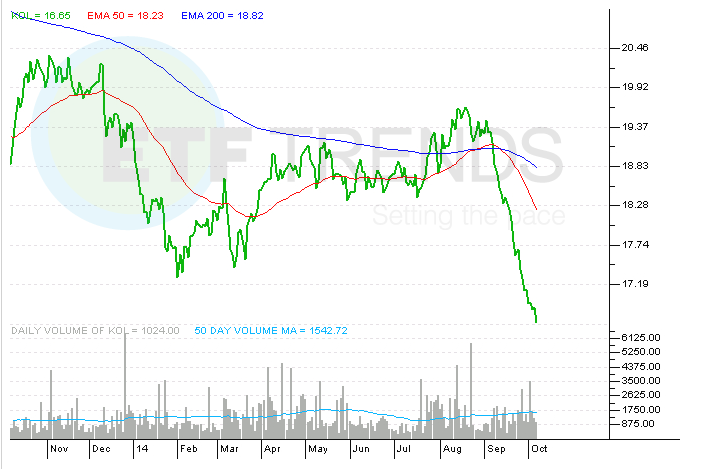
Nearly 20 exchange traded funds related to the energy complex have made new 52-week lows to this point in Wednesday’s trading session and one of those funds is the Market Vectors-Coal ETF (NYSEArca: KOL).
With Wednesday’s 0.4% decline, KOL is now off nearly 14% on a year-to-date basis. With theUnited States Natural Gas Fund (NYSEArca: UNG) trading at its lowest levels since July, the outlook for coal stocks is cloudy at best because coal producers are believed to be beneficiaries of higher natural gas prices, which have previously prompted electric utilities to use more coal in an effort to trim costs. [Natty’s Woes Hit This ETF]
Although the stock accounts for a scant 0.2% of the ETF’s weight, making it the fund’s third-smallest holding, Walter Energy (NYSE: WLT) is again hampering KOL today. In a note out earlier today, Morgan Stanley sounded a skeptical tone about Walter and Alpha Natural Resources (NYSE: ANR).
Shares of Walter are down about 4.7% and trading below $2. Alpha Natural, 0.65% of KOL’s weight, is trading higher, but struggling to stay above $2. In early 2011, Alpha Natural traded above $65. In July 2011, hedge fund Audley Capital said shares of Walter Energy were worth $240, more than double where the stock traded at the time that audacious claim was made.
The near-term view of thermal coal demand is murky, too, due in part to forecasts calling for a milder winter than what was seen last year.
“Winter is approaching. There have been more discussions about whether coal will be lucky again. Natural gas inventory is falling short compared to the historical average. However, coal demand may not increase as much as last year. A milder winter is expected. Also, there’s lower coal-fired capacity. A milder winter may cause normal electricity demand,” according to Market Realist.
Investors are either undeterred or fiercely loyal to KOL. Despite being down almost 14% this year, the ETF has pulled in $20.7 million in new assets, a healthy percentage of its current assets under management tally of $153.2 million. KOL slid 8.6% during the third quarter, but that did not keep investors from pouring $6.7 million into the ETF. [Coal ETF Faces Weak Fundamentals]
Coal companies also took a hit after demand for metallurgical coal – coal used in production of metals like steel – faltered on slowing growth in China. In May, coal stocks weakened after Stanford University became the first major university to divest from fossil fuel producers perceived as major polluters.
Market Vectors Coal ETF