Alternative investment exchange traded funds are gaining popularity as a way to diversify a traditional fixed-income and equities portfolio. But how exactly do these alts strategies work?
On a recent webcast, Your Alternatives Strategy in One ETF, Lucian Marinescu, portfolio manager at Ibbotson Associates, explains that Morningstar breaks down the alternative investments space into two categories: Alternative Alpha and Alternative Beta.
Specifically, alternative alpha includes investment themes that have low correlations to traditional investments, such as long/short equity, merger arbitrage and managed futures. On the other hand, alternative beta is comprised of asset classes that show low correlations to traditional investments, including infrastructure, private equity and Treasury Inflation Protected securities.
Essentially, these types of investment themes or asset classes generally move in a different direction than traditional investments, which helps diminish a portfolio’s volatility.
“A good alternative investment is one that produces positive risk-adjusted returns (over a reasonable time frame) and exhibits a low correlation to traditional investments,” Marinescu said.
For instance, Marnescu explains how ProShares Morningstar Alternatives Solution ETF (NYSEArca: ALTS) includes risk mitigating assets, coupled with some return enhancers. ALTS includes exposure to low risk assets and strategies like bonds, TIPS, managed futures, merger arbitrage, hedge fund styles and long/short equity. Additionally, the ETF includes return enhancers like U.S. equities, foreign stocks, global infrastructure and private equity.
ALTS acts like a sort of fund-of-funds, tracking a Morningstar index comprised of ProShares ETFs. The ETF’s holdings include ProShares RAFI Long/Short (NYSEArca: RAFI) 24.5%, ProShares Hedge Replication ETF (NYSEArca: HDG) 22.2%, ProShares Managed Futures Strategy (NYSEArca: FUTS) 18.2%, ProShares DJ Brookfield Global Infrastructure ETF (NYSEArca: TLZ) 15.9%, ProShares Merger ETF (NYSEArca: MRGR) 10.9%, ProShares Global Listed Private Equity NYSEArca: (PEX) 5.8%, ProShares 30 Year TIPS/TSY Spread NYSEArca: (RINF) 2.6%.
In the ever changing environment, investors are adapting their portfolios to meet market shifts. Currently, bond yields are at historically low yields and mixed economic signals are raising concerns over the equities markets, Simeon Hyman, head of investment strategy at ProShares said. [How to Use Alts ETFs in Client Portfolios]
With the proliferation of ETF strategies available, more are turning to alts funds. Alternative mutual funds attracted $40.3 billion in net inflows over 2013, with 70 new alternative mutual funds and 29 alts ETFs launched. An additional 17 new funds came to market over the first quarter of this year.
“Seventy-seven percent of advisors said that diversification is still the top driver of investment in alternatives,” Hyman said. “Sixty percent of advisors allocate between 6% and 20% to alternatives, while a large portion of institutions (18%) allocate more than 40% to alternatives.”
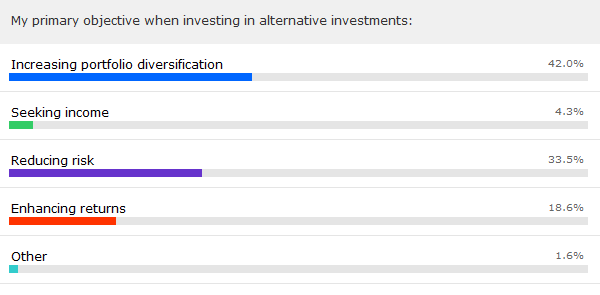
In a recent ETF Trends survey, the majority of financial advisors also expressed their desire to utilize alternative investments to increase portfolio diversification and risk management.
Financial advisors who are interested in learning more about alternative investment strategies can view the webcast here on demand.