Diwali, the Indian festival of lights, starts on Thursday Oct. 23. The celebration symbolizes the lifting of spiritual darkness, but it could shine new light on exchange traded funds holding Indian stocks.
Led by the Market Vectors India Small-Cap Index ETF (NYSEArca: SCIF), four India ETFs rank among the top-10 non-leveraged ETFs in 2014, according to ETF Replay data. SCIF entered Tuesday with a 37.2% year-to-date gain while the average 2014 gain for the WisdomTree India Earnings Fund (NYSEArca: EPI), iShares India 50 ETF (NasdaqGM: INDY) and the PowerShares India Portfolio (NYSEArca: PIN) are up an average of almost 27% this year. [The Dominance of India ETFs]
Those gains might imply further upside for India ETFs is limited, but data from previous Diwali trades prove otherwise. Going back to 1995, India’s benchmark CNX Nifty Index has fallen only five times from the start of Diwali through the end of the year, according to Paststat.com. The CNX Nifty’s average gain from the start of Diwali through yearend over those years has been a tidy 5.4%, according to Paststat.
Investors may not want to wait for Diwali to start before considering the aforementioned ETFs. As Paststat notes, buying Indian stocks the day before the festival starts, which in this case would be Wednesday Oct. 22, and holding through Dec. 31 adds an advantage of 50 basis points to the Diwali trade.
Of course, seasonal trades must be confirmed by other indicators and these trades are far from a free lunch. Additionally, investors must acknowledge the driving forces behind the rally in Indian stocks this year.
For example, EPI, the largest India ETF, is by far the top performer among the four major single-country ETFs tracking BRIC nations due in large part to Narendra Modi’s win in the recent national elections. Some analysts believe Modi must take steps to loosen India’s foreign direct investment restrictions to propel Indian equities higher.
For its part, EPI is a different animal among India ETFs due to its weighting methodology that emphasizes allocations to the most profitable companies. WisdomTree points out that the most profitable companies in EPI’s selection universe will occupy the largest weights within the ETF while stocks that have been recent tears see their weights pared in favor of making room for laggards that have the potential to be the next batch of Indian leaders. That methodology helps EPI’s lineup appear inexpensive relative to other India benchmarks. [Buying the Dip in India ETFs]
“Because India is the only major emerging market where the trend is your friend at the moment. China is dealing with overcapacity and bad debt, plus the unrest in Hong Kong; Russia has capital flight, a weakening currency and declining energy prices; Brazil is in recession and also suffers from weak commodity markets. India’s economy slowed earlier than the other BRIC countries, and it’s the only one where clouds seem to be lifting,” said AltaVista Research in a recent note.
The research firm adds “Investors have certainly begun to revalue Indian stocks, although they remain well within historical ranges vis-à-vis other emerging markets. Specifically, Indian stocks in EPI enjoyed as much as a 55% premium on their price-to-book value multiple versus their counterparts in EEM back in 2010. That fell gradually in recent years, to a discount of 13% in late 2013. But since then investors reversed course, sending the relative P/BV multiple back into premium territory.”
Diwali Trade Data
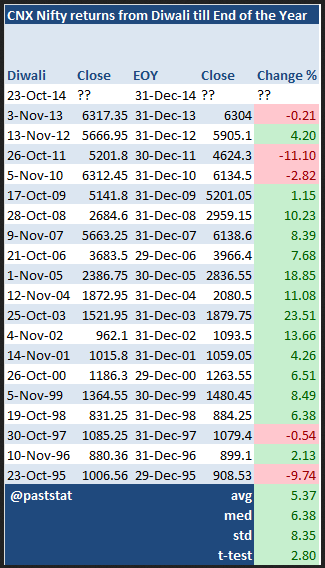
Table Courtesy: Paststat.com