While there are many investment assets available on the market, investors should keep in mind that a core dividend growth exchange traded fund could help diversify a portfolio and potentially generate better risk-adjusted returns.
On the recent webcast, Re-Think Your Core: the Case for Dividend Growth, Dan Sanborn, senior U.S. market analyst for Ned Davis Research Group, points out that a dividend strategy has outperformed over time while diminishing potential downside risks.
“Over the long run, companies that have paid dividends have outperformed those that have not,” Sanborn said. “Moreover, companies that have grown their dividend have outperformed the broad group of dividend-paying stocks.”
Dividend stocks still rise and fall along with the broader equities space. However, dividend growers typically show less volatility, which is a major factor for many financial advisors, according to a recent ETF Trends survey.
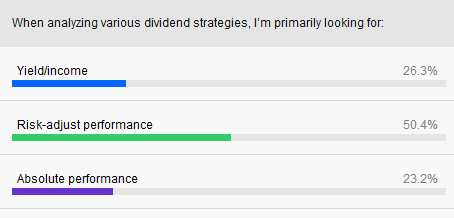
Dividend growers’ ability to cushion the downside help them outperform the broader market over the long term.
“When compared to the S&P 500, growers tend to perform in-line and in some cases better during bull markets, and they don’t go down nearly as much during bear markets,” Sanborn added.
The trend is not limited to the U.S. markets. Simeon Hyman, head of investment strategy at ProShares, pointed out dividend-growing stocks have historically outperformed their respective broad equities markets both domestically and abroad, with lower volatility.
For instance, the ProShares S&P 500 Aristocrats ETF (NYSEArca: NOBL) covers high-quality company stocks that have consistently raised their dividends for at least 25 straight years. NOBL has been trading less than a year and generates a 1.95% 30-day SEC yield. [Checking in on Dividend Aristocracy]
Additionally, the recently launched ProShares MSCI EAFE Dividend Growers ETF (NYSEArca: EFAD) provides access to developed market stocks outside of North America that have raised their dividends for at least 10 years and equally weights holdings. EFAD has a 1.75% 30-day SEC yield. [Going Global for Dividend Growth]
Anil Rao, V.P. of index applied research for MSCI, explained how EFAD has also exhibited lower volatility and a smaller cap bias — factors that have earned persistent premiums over long periods of time.
In anticipation of a rising rate environment. Sanborn also notes that dividend stocks typically perform better when rates are flat or falling, but dividend growers will still hold up as rates rise.
Hyman also points out that both NOBL and EFAD underweight utilities and telecom stocks, both sectors that are more sensitive to changes in interest rates. NOBL includes a 1.8% position to utilities and telecom names while EFAD has 9.6% in utilities.
“Falling interest rates in the first half of this year were a key ingredient in utilities’ outperformance. And rising interest rates were key to utilities’ underperformance in the second half of last year,” Hyman said.
Financial advisors who are interested in learning more about investing in dividend ETF strategies can listen to the webcast here on demand.