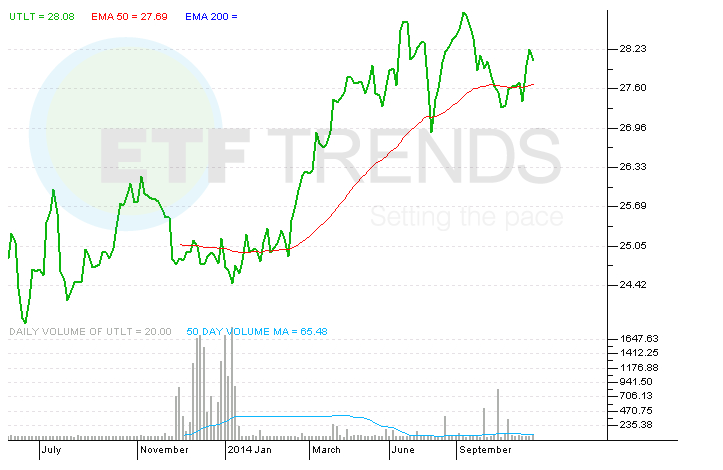
With volatility on the rise and stocks doing the opposite, investors are taking refuge in the welcoming arm of a familiar sector: Utilities.
One of the S&P 500’s smallest sector weights is the benchmark U.S. index’s best-performing group this year with the Utilities Select Sector SPDR (NYSEArca: XLU) sporting a 14.7% gain. XLU has rewarded conservative investors and those investors have shown their appreciation, pouring over $176 million into the largest utilities ETF since the start of this month. [Utilities ETF Prove Sturdy Amid Tumult]
Although the utilities sector has a reputation for being boring, exchange traded funds offer investors different ways of accessing the sector, including the Deutsche X-Trackers Regulated Utilities Fund (NYSEArca: UTLT). UTLT, which debuted in June 2013, is up a tidy 13.7% this year.
The ETF is the first to exclusively focus on regulated utilities. “A company is considered to be in the regulated utilities sector if its ancillary, non-utility businesses are/or unregulated utilities business does not represent more than 25% of the company’s earnings before interest, taxes, depreciation and amortization (“EBITDA”),” according to Deutsche Asset & Wealth Management.
UTLT differs from rivals, such as XLU, in another way: The former is a global ETF. Although nearly three-quarters of its weight is allocated to U.S. companies, UTLT features some global exposure, including an almost 7.7% weight to the U.K. and a 6.7% allocation to Canada.
Seven of UTLT’s top-10 holdings are U.S.-based companies, including familiar names such as Southern (NYSE: SO), Duke Energy (NYSE: DUK) and American Electric Power (NYSE: AEP). As has been previously noted, developed market dividend payers often feature higher yields than their U.S. counterparts from the same sectors and that is true of UTLT as the ETF sports a trailing 12-month yield advantage of about 10 basis points over XLU. [Strong Yields on Global ETFs]
According to the U.S. Energy Information Administration, U.S. electricity sales to the residential sector are expected to be 1.7% higher in 2014 year-over-year but fall by 0.3% in 2015. Additionally, U.S. commercial sector electricity is expected to average 0.9% higher in 2014 and grow 0.4% in 2015.
UTLT, which tracks the DBIQ Regulated Utilities Index, charges 0.45% per year.
Deutsche X-Trackers Regulated Utilities Fund