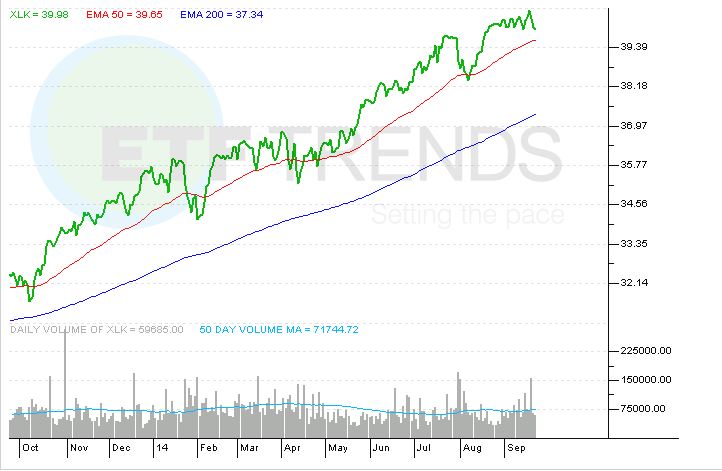
A strong performance over the past several months has helped elevate the Technology Select Sector SPDR (NYSEArca: XLK) to the third spot among the nine sector SPDR exchange traded funds.
Up 13.6% this year, XLK, the largest technology sector ETF, trails only the Health Care Select Sector SPDR (NYSEArca: XLV) and the Utilities Select Sector SPDR (NYSEArca: XLU) on a year-to-date basis. Although tech is home to an array of older, mature companies, it is still perceived as a glamor sector and one that makes for great news fodder when the sector is performing well. That also means investors should examine tech ETFs and the holdings of those funds before rushing in.
The time could be now to give XLK and rival tech ETFs a look due to the sector’s tendency to outpace the broader market during the fourth quarter.
“Sam Stovall, managing director-U.S. equity strategy for S&P Capital IQ, notes that the S&P 500 information technology sector has been the strongest sector performer during the fourth quarter, rising 6.6% on average, ahead of the5.0% gain for the broader market. Further he highlights that with a P/E-to-projected EPS growth rate of 1.3X, the tech sector is the third lowest of the ten GICS sectors and he believes the technical trends for the sector are favorable,” said S&P Capital IQ in a new research note.
Indicating that investors should in fact be choosy when it comes to tech ETFs, S&P Capital notes it has strong buy or buy ratings on just 57 of the 187 tech stocks in its coverage universe. XLK has added $719 million in new assets this quarter, the most among tech ETFs.
XLK, which the research firm rates overweight, has a long-standing reputation as one of the premier destinations for investors seeking to access Apple (NasdaqGS: AAPL) via ETFs. The fund sports a nearly 16% weight to iPad maker, a nice feather in its cap during a year in which Apple has climbed 29%. [Check Your ETF’s Apple Weight]
XLK has also benefited as investors have sought refuge from the volatility of social media, Internet and less mature tech stocks with older, more established fare. On a year-to-date basis, XLK has been less volatile than XLV and, perhaps surprisingly, XLU. Part of the reduced volatility among older tech firms has come by way of their increased prominence as dividend stocks.
The average payout increase from Apple, IBM (NYSE: IBM), Cisco (NasdaqGS: CSCO) and Qualcomm (NasdaqGS: QCOM) this year is almost 14%. Microsoft (NasdaqGS: MSFT) recently kicked in an 11% payout boost. Those stocks combine for nearly 37% of XLK’s weight. [Rising Tech Dividends Lift ETFs]
As S&P Capital IQ notes, XLK includes telecom stocks, but the rival Vanguard Information Technology ETF (NYSEArca: VGT) does not, offering a purer tech sector experience.
“The $6 billion ETF has no telecom services stocks but does include some mid- and small-caps. The median market capitalization of its holdings was just $1.8 billion, much lower than the $16 billion of XLK, and, not surprisingly, its three-year standard deviation of 13.6 was also higher than XLK’s 11.6. Yet because there is still a lot of overlap in its holdings, VGT’s ranking is also aided by the Fair Value and Credit Ratings of its holdings,” said the research firm.
VGT is two basis points per year cheaper than XLK, but the Vanguard offering has a wider bid/ask spared and has lagged XLK this year, according to S&P Capital IQ.
Apple, Microsoft, IBM, Qualcomm and Cisco combined for almost 34% of VGT’s weight at the end of August, according to Vanguard data.
Technology Select Sector SPDR
Tom Lydon’s clients own shares of Apple.