Although none of its weight is allocated to the energy sector, the iShares MSCI Mexico Capped ETF (NYSEArca: EWW) has climbed 13.4% over the past six months in part because of Mexico’s plans to liberalize its energy sector.
Earlier this year, Mexican President Enrique Peña Nieto signed legislation that ended the 75-year run of control over the country’s energy industry by state-owned oil company Pemex. Nieto’s energy reforms were announced last year as a way of stemming the tide of a decade’s worth of falling production by Pemex and as a way of attracting needed foreign investment to Mexico’s energy industry.
Now, some of the biggest names in the international oil business are eager to tap Mexico’s lush reserves. Global oil giants from Exxon Mobil (NYSE: XOM), the largest U.S. oil company, to Royal Dutch Shell (NYSE: RDS-A), Europe’s largest oil company, are eager to get to work in Mexico. [ETFs for Mexico’s New Oil Industry]
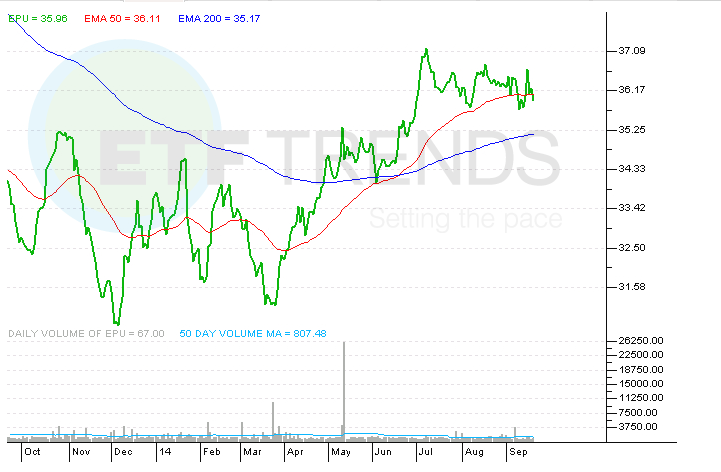
Peru could have similar designs, but how opening Peru’s energy industry affects the iShares MSCI All Peru Capped ETF (NYSEArca: EPU) remains to be seen.
“Peru looks to expand its gas output from its Camisea field moving forward, in addition to streamlining regulation as the nation struggles to fill the void in the decline of its national oil exploration and production,” according to Emerging Equity.
Like Mexico, Peru’s oil production has been declining and although Peru’s oil reserves are not as bountiful as Mexico’s, the latter is home to “the eighth largest crude oil reserve holder in Central and South America, with 633 million barrels of proved reserves, as of January 2014, according to Oil and Gas Journal.
And like EWW, EPU, the lone Peru ETF, has scant energy sector exposure. The Peru ETF allocates less than 1.5% of its weight to the energy sector. Peru is also lagging other South American rivals in bolstering its oil production.
“Last year there were only seven exploratory wells drilled in Peru compared to a total of 115 that were drilled in Colombia,” according to Emerging Equity. Over the past three years, EPU has fallen almost 6% while the Global X MSCI Colombia 20 ETF (NYSEArca: GXG) is higher by nearly 4%. [GDP Surge Lifts Colombia ETFs]
Colombia is one of the fastest-growing oil producers in the world and Mexico’s emergence as a more legitimate player on the Latin America oil stage could be signs “Peru risks losing energy investment in light of Mexico’s landmark energy reforms,” according to Emerging Equity.
Some sector diversity for Peru’s fast-growing economy could serve it and EPU well. Although the ETF is up 8.1% this year, EPU has lost nearly $30 million in assets due to the fund’s long-standing and intimate correlations to gold and silver prices.
Peru is one of the largest silver producers and a major gold producer as well, facts highlighted by EPU’s 49.4% weight to the materials sector. That trait has, historically, made EPU vulnerable at times of retreating gold and silver prices.
iShares MSCI All Peru Capped ETF