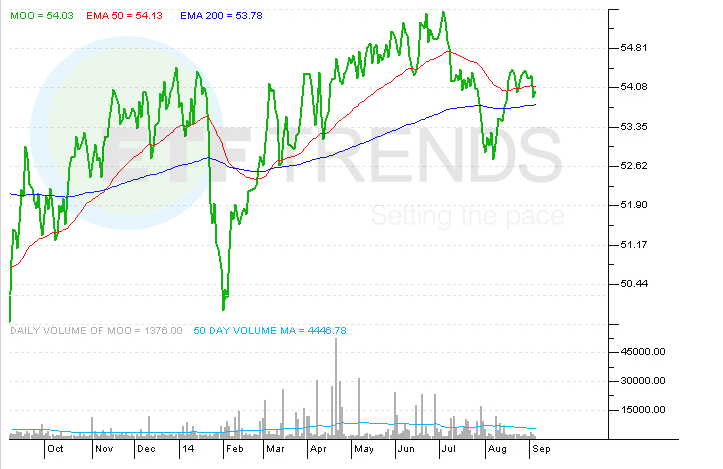
The Market Vectors Agribusiness ETF (NYSEArca: MOO) is up just half a percent this year and barring an epic turnaround, MOO will lag the S&P 500 once again.
Since 2008, MOO has only outperformed the S&P 500 twice with the last occurrence in 2010. Some frustrated investors have been departing MOO and doing so in droves. The $21.7 million in assets MOO bled last week barely scratches the surface of the $2.85 billion the ETF has lost this year. [The Fallacy of Flows]
Only two ETFs – the SPDR S&P 500 ETF (NYSEArca: SPY) and the PowerShares QQQ (NasdaqGM: QQQ) – have lost more money than MOO this year.
“Consider: Since July 2011, the S&P 500 has produced a total return of around 60%. MOO has underperformed badly and is only up around 5% over the same time period,” writes Alan Gula for Wall Street Daily.
MOO was once a $6 billion fund and the largest equity-based offering in the Market Vectors lineup. It is now a $1.7 billion ETF, or less than a third of the size of the $7.5 billion Market Vectors Gold Miners ETF (NYSEArca: GDX).
Bumper crops in the U.S. for corn and soybeans, among other agriculture products, have recently been problematic for MOO and agribusiness stocks. According to the Department of Agriculture, lower corn and soybean prices have cut U.S. farmers’ profits to an estimated $113.2 billion in 2014, a 14% drop from last year, Bloomberg reports.
Projected income for U.S. farmers is the lowest it has been since 2010. Six of MOO’s top-10 holdings are up this year, but just two – Archer-Daniels-Midland (NYSE: ADM) and Zoetis (NYSE: ZTS) – have posted market-beating gains.
It is stating the obvious, but MOO does need the benefit of higher agriculture commodities prices and even in that case, the reaction of agribusiness stocks to those higher commodities prices is often delayed. That says patience is a virtue with MOO and a virtue that could be tested.
To be fair, MOO is not the only agriculture-related ETF that investors are departing. Agriculture ETFs were beloved by investors through the first quarter and into the early part of the second quarter as uncooperative weather conditions lifted prices for commodities ranging from coffee to cocoa and fears of depressed supply elevated livestock prices. [Investors Leave Ag ETFs as Crop Yields Rise]
Robust corn and soybean crops prompted almost $134 million in third-quarter outflows from the PowerShares DB Agriculture Fund (NYSEArca: DBA).
Market Vectors Agribusiness ETF
ETF Trends editorial team contributed to this post. Tom Lydon’s clients own shares of QQQ and SPY.