Still reverberating in the fixed income world is last Friday’s news that Bill Gross has departed PIMCO, the bond house he founded, for Janus Capital (NYSE: JNS). Not surprisingly, the news of Gross’ acrimonious departure from the company he built has stoked talk of redemptions at PIMCO.
The PIMCO Total Return ETF (NYSEArca: BOND), the actively managed ETF formerly managed by Gross, has lost almost $545 million in the two trading days since he resigned from PIMCO. BOND, the second-largest U.S. actively managed ETF behind its family member, the PIMCO Enhanced Short Maturity ETF (NYSEArca: MINT), lost $446.5 million on Friday Sept. 26, a one-day record, Lisa Abramowicz and Jody Shenn for Bloomberg. Those outflows dipped to $98 million, but investors looking for other fixed income pastures have plenty of exchange traded funds to choose from. [PIMCO Bond ETF Loses $545M After Gross Leaves]
The ETF had $3.11 billion in assets under management as of the close of markets Sept. 29, according to PIMCO. BOND is now being managed by Scott Mather, Mark Kiesel and Mihir Worah. BOND’s major allocations are as follows: 36% to U.S. corporates, 23% to ex-U.S. developed market sovereigns, 27% to mortgage-backed securities and 17% to U.S. government debt.
Investors looking for alternatives can gain access to U.S. government bonds via the iShares 3-7 Year Treasury Bond ETF (NYSEArca: IEI).
“For the government portion and to gain intermediate exposure, we like IEI. The ETF benefits from the strong credit quality one would expect with Treasuries, has a modest 0.15% expense ratio and trades with a tight $0.02 bid/ask spread. The 30-day SEC yield is 1.4%,” said S&P Capital IQ in a note out Tuesday.
The research firm, which rates IEI overweight, notes the ETF’s duration of 4.5 years is lower than the PIMCO Total Return mutual fund, which was also previously managed by Gross. BOND and IEI have comparable durations. [Treasury Demand Lifts Bond ETFs]
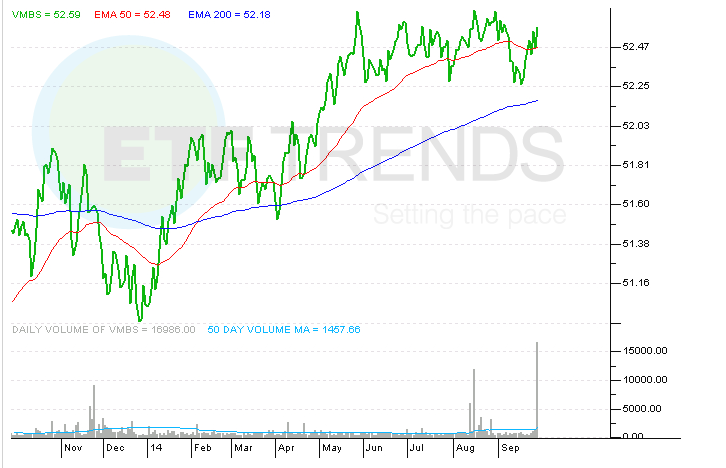
S&P Capital IQ recommends the overweight-rated Vanguard Mortgage-Backed Securities Index ETF (NYSEArca: VMBS) for investors looking to gain exposure to mortgage-backed securities. The ETF tracks U.S. agency mortgage-backed bonds, including Fannie Mae, Freddie Mac, and Ginnie Mae securities. VMBS charges just 0.12% per year. VMBS has a duration of 4.4 years and the 30-day SEC yield is also 1.4%.
S&P Capital IQ highlighted the Vanguard Total International Bond ETF (NYSEArca: BNDX) and the PowerShares Emerging Markets Sovereign Debt Portfolio (NYSEArca: PCY) as options for international bond exposure.
PCY, the second-largest emerging markets bond ETF, has had solid year, gaining 5.3% while adding $387.1 million in new assets. While there has been controversy this year with some emerging markets sovereign issuers, including Standard & Poor’s downgrades of Brazil and Russia to the lowest investment grades and Turkey’s ongoing spat with ratings agencies, PCY has been able to skirt much of that negativity with just a 9.1% combined weight to Turkey and Brazil and no exposure to Russian debt. [Brazil ETFs Deal With Ratings Downgrade]
Two-thirds of PCY’s portfolio is rated AA, A or BBB and the ETF has an effective duration of nine years with a 30-day SEC yield of 4.81%.
BNDX tries to reflect the performance of the Barclays Global Aggregate ex-USD Float Adjusted RIC Capped Index, which includes government, agency, corporate and securitized non-U.S. investment-grade fixed income investments issued in foreign currencies but also includes a hedge to its currency exposure.
BNDX’s currency hedge should prove useful going forward if the current trend of dollar strength and falling currencies in other developed markets stays in place. BNDX utilizes one-month forward currency contracts, which are rebalanced monthly, to hedge its currency exposure. BNDX has an average duration of seven years and charges 0.2% per year, making it less expensive than 81% of comparable funds, according to Vanguard. S&P Capital IQ rates BNDX and PCY marketweight.
“Now of course instead of possibly benefiting from the security selection PIMCO and other active fund managers offer, you would have a more passive portfolio. However, in light of the relatively weak recent track record of PIMCO Total Return, perhaps you would be better suited aiming to replicate well-known benchmark,” said S&P Capital IQ.
Vanguard Mortgage-Backed Securities ETF