U.S.-listed exchange traded funds added $14.8 billion in new assets last month, but despite August being the best month for U.S. stocks since February, fixed income ETFs led in terms of monthly inflows.
Fixed income ETFs added $8.36 billion in new assets last month compared to $5.98 billion for equity-based funds, according to data from State Street Global Advisors, the second-largest U.S. ETF issuer.
“Risky assets bounced back after a soft July on the typical low volume that August usually brings. Markets mostly brushed off the rising tensions in the Middle East and Ukraine to grind higher. Bond prices were also up and the gap between US Treasuries and German Bunds continued to widen. As the euro and yen weakened, the US dollar gained on the month highlighting the growing divergence of monetary policy,” said State Street Global Advisors Vice President and Head of Research Dave Mazza in research released Thursday.
ETFs holding U.S. Treasuries, particularly the longer duration variety, were prolific asset gatherers in August. Treasury ETFs posted their best monthly performance since January, helping drive $1.47 billion of new assets into the iShares 7-10 Year Treasury Bond ETF (NYSEArca: IEF), the top total among all ETFs for August. The iShares 20+ Year Treasury Bond ETF (NYSEArca: TLT) added $564.7 million last month. [Treasury ETFs Notch Best Month Since January]
The recent run-up in Treasury ETFs has prompted some market observers to make bearish calls on the likes of TLT and others. Some traders are following that advice, as evidenced by the ProShares UltraShort 20+ Year Treasury (NYSEArca: TBT), a double-leveraged bearish play on TLT, adding $1.25 billion in assets this year. [Shorting Treasury ETFs?]
Among equity-based ETFs, investors’ thirst for sector funds remains strong.
“In the US, sector ETFs continue to dominate flows as investors embrace more nuanced exposures to the market to balance risk and reward. Consumer discretionary, consumer staples and Health Care took in a disproportionate share of flows. While energy and financials saw modest outflows, Utilities experienced the largest outflow on an AUM and percentage basis,” said Mazza.
Outflows from utilities ETFs could be viewed as interesting given the sector’s stout performance this amid declining Treasury yields and the reputation of the Utilities Select Sector SPDR (NYSEArca: XLU) for being the second-best of the nine SPDR ETFs in August and the best of the nine in September. [Sector ETF Ideas for September]
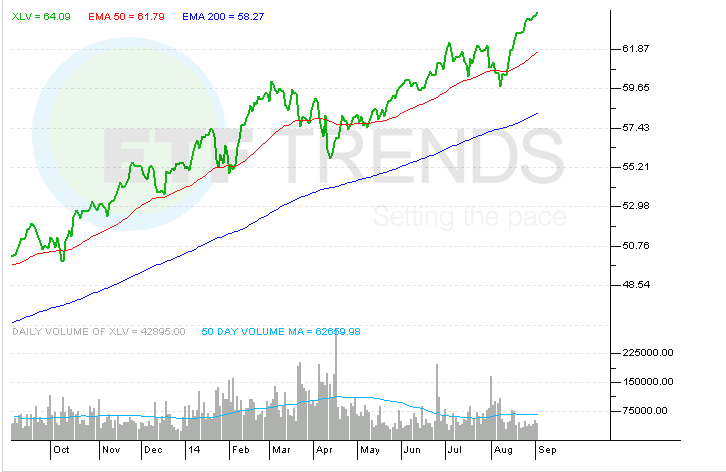
No sector ETF has gained more than the $1.7 billion added by the Consumer Discretionary Select Sector SPDR (NYSEArca: XLY) since the start of the current quarter. Last month, health care ETFs added nearly $1.2 billion in new assets, led by almost $753 million of flows into the Health Care Select Sector SPDR (NYSEArca: XLV).
Investors have been flocking back to health care ETFs due in part the resurgence of biotechnology stocks and funds. After swooning earlier this year, biotech ETFs have reclaimed those losses and then some, recently moving to fresh all-time highs. The First Trust NYSE Arca Biotechnology Index Fund (NYSEArca: FBT) was August’s best-performing non-leveraged ETF with a gain of 14%. [Biotech ETFs Can Build on August Returns]
“Developed market central banks continue to make the case that the cost of doing too little outweighs the cost of doing too much. Due to the impact of QE, investors have been searching for yield and driving down credit spreads. As such, other than the influence of swings in sentiment and technical factors, there is little reason to believe this will change.
“At this stage in the cycle, we may see investors favoring equities over credit as EPS rises, but so does leverage. With US interest rate forecasts decreasing, the carry trade for emerging markets should continue to help EM markets. Cyclicals also continue to look more favorable than defensives. All in all, the Goldilocks economy seems to taking shape but the three bears could be right around the corner,” added Mazza.
Health Care Select Sector SPDR
ETF Trends editorial team contributed to this post. Tom Lydon’s clients own shares of TLT.