Amid fresh economic sanctions from the U.S. and Europe, exchange traded funds holding Russian equities are languishing through another trying week.
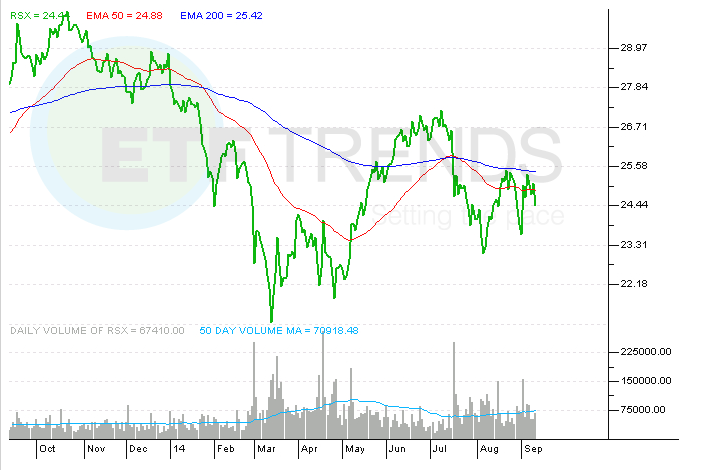
The Market Vectors Russia ETF (NYSEArca: RSX) fell 2.5% Thursday to bring its weekly loss to 2.4%. The iShares MSCI Russia Capped ETF (NYSEArca: ERUS) was off 2.9% as it and RSX were two of the four worst-performing non-leveraged ETFs on the day.
U.S. and European authorities are expected to unveil specific sanctions against Russia for its role in backing separatists in the now months-long conflict with Ukraine. However, it is expected the new sanctions from the West will target Russia’s defense, energy and financial services sectors, according to the New York Times.
In particular, additional sanctions against the energy and financial services sectors could deal blows to Russia ETFs. Reflective of the country’s status as one of the largest non-OPEC oil producers in the world, RSX and ERUS feature energy weights of 42% and 47.6%, respectively. And reflective of Russia’s financial market composition, the two ETFs also have large financial services weights of 16.7% in ERUS and 11.1% in RSX. [Plenty of Headwinds for Russia ETFs]
Although there have been pockets of strength for Russia ETFs in recent months, namely when Russian President Vladimir Putin publicly discusses a cease-fire with Ukraine, the path of least resistance has been lowered for the already imperiled group. [Sage Advice for Trading Russia ETFs]
RSX, the largest and most heavily traded Russia ETF, is the worst performer among the four major single-country BRIC ETFs this year and the only one of the quartet in the red year-to-date.
RSX “has fallen 8.8 percent in the past two months, the most among emerging-market ETFs with assets of $1 billion or more,” reports Halia Pavliva for Bloomberg.
With Russia’s benchmark Micex Index trading at valuations that are roughly half those found on the iShares MSCI Emerging Markets Index, some market observers have opined Russia is a value trap due to the current geopolitical headwinds. RSX had a trailing 12-month P/E ratio of just 5.8 and a price-to-book ratio of just 0.8 at the end of August, according to Market Vectors data.
That outlook comes among increasing concerns about Russia’s GDP growth were announced, according to Bloomberg. Russia’s 2014 economic growth, which was forecast at just 0.5% before the most recent sanctions were unveiled. Some investors remain optimistic about upside for Russia ETFs as highlighted by $154.6 million in third-quarter inflows to RSX.
Market Vectors Russia ETF