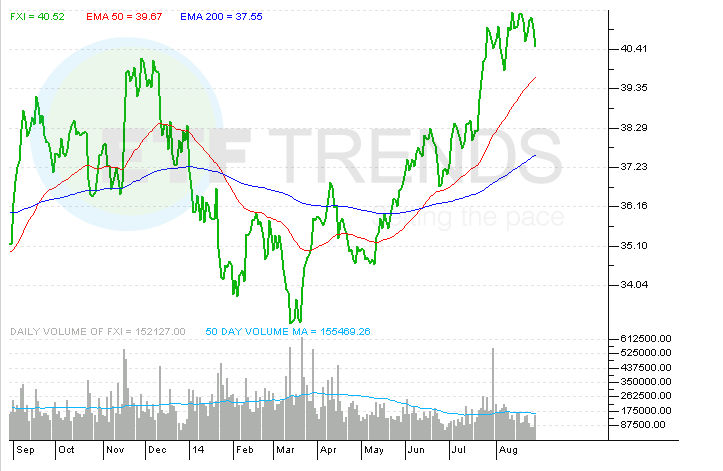
After struggling through the first quarter and lagging a rebound in emerging markets exchange traded funds that started in February, ETFs holding Chinese stocks are rewarding investors.
Investors are saying thank you by allocating fresh capital to China funds, such as the iShares China Large-Cap ETF (NYSEArca: FXI).
FXI, the largest and most heavily traded China ETF, “has attracted a net $518 million in August, putting it on track for the biggest monthly inflow since $1.34 billion was added in December 2012,” reports Belinda Cao for Bloomberg.
After the aforementioned first-quarter struggles, FXI is up 10.7% in the past 90 days, but year-to-date, the ETF is just the third-best of the four major single-country BRIC ETFs. Only the Market Vectors Russia ETF (NYSEArca: RSX) has been worse.
FXI, which had $5.8 billion in assets under management as of Aug. 28, has been sparked by Tencent Holdings (OTCBB: TCEHY), which is up nearly 12% over the past three months, and China Mobile (NYSE: CHL). Shares of the telecom giant have surged 26.8% in the past 90 days. Those stocks combine for 19.6% of FXI’s weight. [China ETFs Continue to Impress]
Often criticized for its large weight to the financial services sector, which currently rests at 53.6%, that hefty exposure has worked in FXI’s favor this year as Chinese banks have rallied. Dividend growth by banks there has made China the largest dividend payer in the developing world. [China’s Dividend Growth Story]
FXI’s roster of 26 stocks will grow to 50 next month when the ETF transition to the FTSE China 50 Index at the close of U.S. markets on Sept. 19.
FXI is not the only China ETF that has added assets this month. The iShares MSCI China ETF (NYSEArca: MCHI) and the SPDR S&P China ETF (NYSEArca: GXC), two ETFs with reputations for outperforming FXI over long-term time frames, have gained $141.6 million and $65.3 million, respectively, this month. Over the past three years, GXC is up 30.4% compared to 19.2% for FXI. [Bigger Not Better for This China ETF]
Part of the reason investors are returning to China ETFs is compelling valuations. Those compelling valuations are also luring investors to A-shares ETFs. The CSI 300 Index, which tracks stocks listed on the Shanghai and Shenzhen exchanges, trades at a price-to-earnings ratio of less than 10, the lowest in over a decade, while Chinese shares listed on the Hong Kong exchanges trade at over 12 times earnings. A-shares are trading at their largest discount to H-shares in five-years. [An A for A-Shares ETFs]
The Deutsche X-trackers Harvest CSI 300 China A-Shares Fund (NYSEArca: ASHR), the largest U.S.-listed China A-shares ETF, has gained 8.2% this quarter while adding almost $56 million of its $340.7 million in assets under management this month.
iShares China Large-Cap ETF