ETF Spotlight on the PowerShares FTSE RAFI Emerging Markets Portfolio (NYSEArca: PXH), part of an ongoing series.
Assets: $385.2 million
Objective: The PowerShares FTSE RAFI Emerging Markets Portfolio tries to reflect the performance of the FTSE RAFI Emerging Markets Index, which is comprised of the largest emerging market equities selected based on fundamental measures, like book value, cash flows, sales and dividends.
Holdings: Top holdings include Gazprom 4.2%, Petroleo Brasileiro 3.3%, China Construction Bank Corp 2.7%, Petroleo Brasileiro 2.7% and Industrial & Commercial Bank of China 2.4%.
What You Should Know:
- Invesco PowerShares sponsors the fund.
- PXH has a 0.49% expense ratio.
- The ETF has 338 holdings and the top ten components make up 25.9% of the overall portfolio.
- Sector allocations include financials 30.2%, energy 23.7%, information tech 10.4%, materials 10.3%, telecom services 9.8%, consumer staples 4.4%, utilities 3.7%, consumer discretionary 3.7%, industrials 3.6% and health care 0.3%
- Country allocations include China 22.5%, Brazil 22.0%, Taiwan 13.3%, Russia 10.5%, South Africa 8.2%, India 6.7%, Mexico 4.3%, Turkey 2.9%, Malaysia 2.5% and Thailand 2.2%.
- “Fundamental indexes attempt to address a problem with cap-weighted indexes–that the latter overweights expensive stocks,” according to Morningstar analyst Patricia Oey. “This methodology has historically resulted in tilts towards mega-cap stocks and value names.”
- Market-cap and style allocations include large-cap value 44.3%, large-cap blend 30.5%, large-cap growth 15.8%, mid-cap value 4.7%, mid-cap blend 2.8%, mid-cap growth 1.0%, small-cap value 0.7% and small-cap blend 0.1%.
- The ETF shows cheap valuations, with a price-to-earnings ratio of 8.93 and a price-to-book value of 1.04.
- PXH is up 2.2% over the past month, up 9.0% over the past three months and up 7.3% year-to-date.
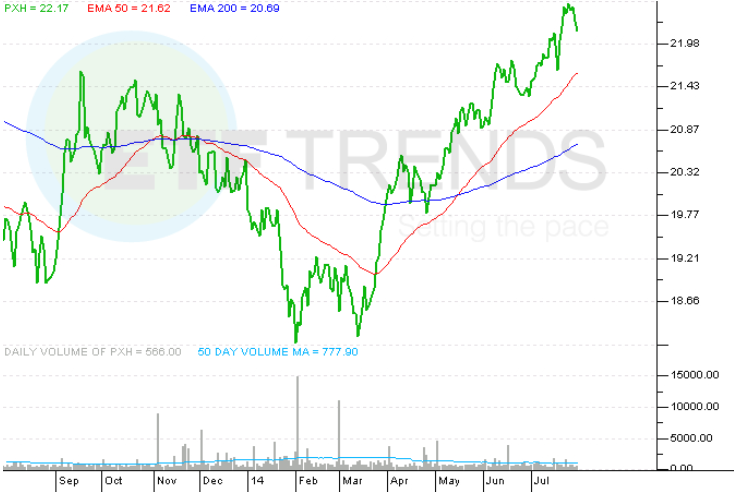
- The fund is trading 5.3% above its 200-day exponential moving average.
- “The fundamental weighting methodology employed by this ETF usually results in a portfolio that has even more exposure to government-controlled firms, as most of these companies are significantly larger (as measured by revenue, cash flow, or market capitalization) than privately owned firms,” Oey said.
Next page: The latest news
The Latest News:
- The emerging markets posted their largest weekly loss since March due to weak earnings in Asia and Argentina’s bond default concerns, Bloomberg reports.
- Additionally, ongoing tension in eastern Ukraine is fostering a risk-off environment.
- “New sanctions on the Russian economy have contributed to the softness in Russian equities,” Neil Shearing, an emerging-markets economist at Capital Economics Ltd, said in the article. “We could see further downside for EM equities as investors start to pay attention to tighter monetary policy in the U.S.”
- The MSCI emerging markets index dipped to a 12-day low Friday after testing three-year highs earlier in the week, Reuters reports.
PowerShares FTSE RAFI Emerging Markets Portfolio
For past stories in this series, visit our ETF Spotlight category.
Max Chen contributed to this article.