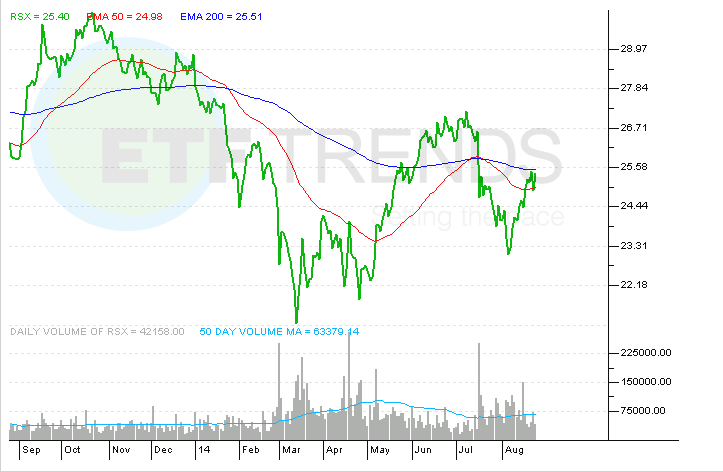
Despite broadening economic sanctions from the West, Russian stocks have been solid in the face of adversity. The Market Vectors Russia ETF (NYSEArca: RSX), the largest and most heavily traded Russia ETF, is up 3.1% over the past month and that could be just the start of more bullish things to come for RSX and rival Russia ETFs.
Amid its conflict with Ukraine, growing fears that it is isolating itself from the West and economic sanctions that have stung a variety of sectors, including energy and financial services, Russia stocks have struggled this year with RSX falling 9.1%. [Russia ETFs Stung by Bank Sanctions]
Russia also saw its sovereign credit rating downgraded by Standard & Poor’s to BBB-, the lowest investment grade rating, in April. Yet, analysts and market observers see significant upside for Russian equities in the year ahead. [Russia ETFs Slip After S&P Downgrade]
Analysts expect Russia’s benchmark Micex Index to surge 27% over the next 12 months, the best expected performance among the four BRIC nations, reports Halia Pavliva for Bloomberg.
Year-to-date, RSX is the worst performer of the four major single-country BRIC ETFs and the only one that has traded lower among itself, the WisdomTree India Earnings Fund (NYSEArca: EPI), the iShares MSCI Brazil Capped ETF (NYSEArca: EWZ) and the iShares China Large-Cap ETF (NYSEArca: FXI).
Some investors continue to be drawn to Russian stocks due to compelling valuations. Russian stocks historically trade at a discount to the broader emerging markets realm, but those discounts have widened over the past year.
In March, Russia’s benchmark Micex was trading at 4.8 times earnings, barely more than a third the valuations on Indian stocks and just over half the P/E on Brazil’s benchmark Ibovespa. That valuation was also less than half of the MSCI Emerging Markets Index and it gave way to RSX and rival Russia ETFs being among May’s top-performing ETFs. [Russia ETFs May Finally be Cheap Enough]
Even on a CAPE basis, Russian stocks are among the least expensive in the world with only a handful of countries showing larger valuation discrepancies to U.S. stocks. The cyclically adjusted price/earnings ratio, or CAPE ratio, differs from the usual P/E ratio that so many investors are familiar with because CAPE evaluates earnings on a 10-year basis.
The Micex trades at 5.3 times projected 12-month earnings, a 57 percent discount to the MSCI Emerging Markets Index, according to Bloomberg.
Some investors are not waiting for further confirmation of a rally in Russian stocks. Since the start of the third quarter, RSX has added nearly $110 million in new assets compared to just $3.2 million for EWZ, the largest Brazil ETF.
Market Vectors Russia ETF