There are about 150 single-country exchange traded funds trading in the U.S., offering investors concentrated exposure to an array of developed and emerging markets.
The single-country ETF space is rapidly expanding. Nearly 30 such ETFs have come to market “within the last two years and about 50 of which were launched over the last three years,” according to BlackRock Managing Director Sue Thompson, CIMA. [Clearing Up Single-Country ETF Misconceptions]
Some ETF strategists employ tactical strategies specific to single-country ETFs.
“Dave Garff, Chief Investment Officer of Accuvest described in early June the company’s International strategy offering as simply overweighting exposure relative to the MSCI ACWI ex- US index to those countries that they believe are most attractive and underweighting those least appealing. Accuvest ranks, on a monthly basis, all developed and emerging market MSCI country indices across four largely equally weighted dimensions. These are fundamentals (e.g. leading indicators and long-term earnings growth), valuation (e.g. price/book and price to cash earnings), risk (e.g. downside volatility and political landscape) and momentum (on a local currency basis),” said S&P Capital IQ in a recent research note.
The countries that rank the highest in the Accuvest model account for the largest positions within the firm’s portfolio.
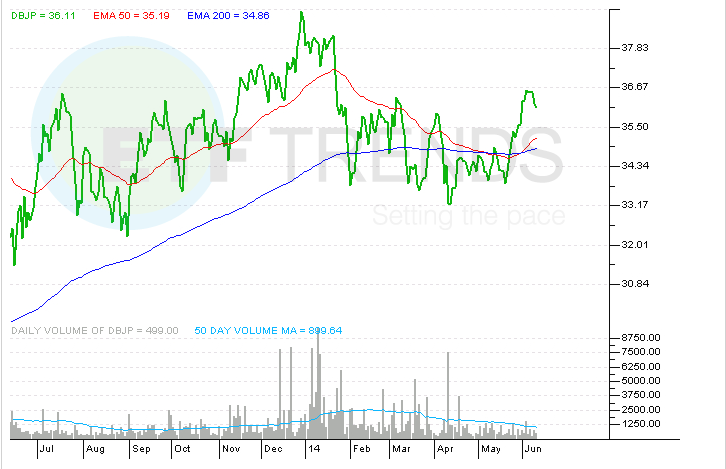
Although the firm recently reduced its stake in the db X-trackers MSCI Japan Hedged Equity Fund (NYSEArca: DBJP), it was still the third-largest portfolio at the end of May, according to S&P Capital IQ. Japanese stocks started the year in lethargic fashion, but have come roaring back over the past two months.
Bolstered by a weaker yen, compelling valuations that recently dipped below those on U.S. equities and news that Japan’s $1.26 trillion public pension fund plans to invest more in equities, Japanese stocks have rallied. DBJP, which S&P Capita IQ rates marketweight, is up 8.7% since April 11. [Pension Infusion Will Lift Japan ETFs]
Accuvest is also overweight Chinese stocks via the iShares MSCI China ETF (NYSEArca: MCHI), citing “relatively strong fundamentals, valuation and risks for China. The ETF, which has a 0.61% expense ratio, ranks favorably to S&P Capital IQ for the attractive valuation and modest risk of its holdings, according to S&P Capital IQ STARS and Quality Rankings,” said S&P Capital IQ. [China ETFs Surge, but No One Cares]
The research firm rates MCHI marketweight.
Countries that made noticeable moves in Accuvest’s June rankings, include Norway and Indonesia, which have ascended to the second and fifth spots, respectively.
“The P/E on Norway is 13.3 compared to the average country at 16.9,” said Accuvest while noting Indonesian is “the second best performing market this year, up 22.97%. Additionally they have one of the best fundamental profiles showing the highest ROE and internal growth rate.”
The Global X Norway 30 ETF (NYSEArca: NORW) is up 12% in just the past three months while the iShares MSCI Indonesia ETF (NYSEArca: EIDO) and the Market Vectors Indonesia Index ETF (NYSEArca: IDX) are two the top-performing emerging markets single-country ETFS this year with an average gain of over 22%. [Favoring Indonesia Over China]
db X-trackers MSCI Japan Hedged Equity Fund