Broadly speaking, Latin American equity markets are volatile compared to developed markets, such as the U.S. or Western Europe.
With the World Cup looming, volatility in markets from host nation Brazil to Chile to Mexico could be benign with volume drying up as traders in the football-mad region focus more on the matches on the field then those on their trading monitors.
A 2012 study by the European Central highlighting the impact of the World Cup on trading volumes in football-crazed developed and emerging markets during the 2010 World Cup.
“The survey studied markets in 15 countries, including nine in Europe, four in Latin America, the U.S., and the 2010 World Cup host South Africa. The study showed a sharp drop in trading volumes, not only in emerging markets, but also in developed markets,” according to Emerging Equity.
The median volume drop across all 15 markets was 55% with the U.S. showing a larger decrease (43%) than the nine European markets included in the survey (38%), Emerging Equity notes.
“Chile saw the sharpest drop in trading activity as volume plunged 99.5% when their national team was playing and 79% when other nations were playing while Brazil saw a fall of 74.5% in trading volume when their national team was playing and a 28.5% fall when other nations were playing,” according to Emerging Equity.
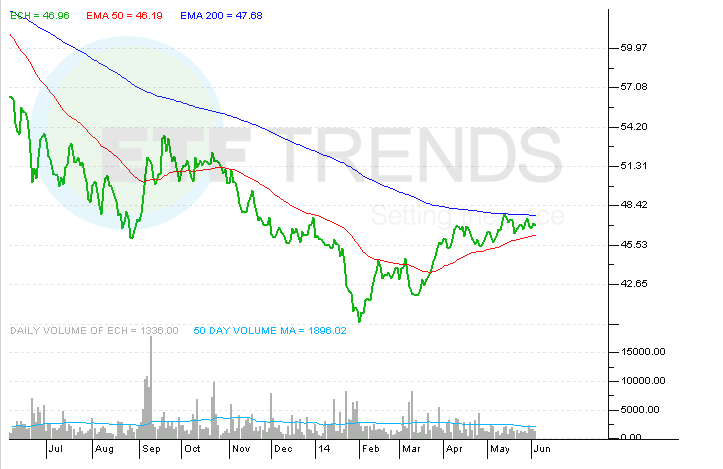
It would appear safe to say that the iShares MSCI Chile Capped ETF (NYSEArca: ECH) could be a slow mover when the World Cup commences next week. Diversified and single-country emerging markets ETFs often act as price discovery vehicles during U.S. market hours because when the U.S. is open, most emerging markets are closed.
For example, about 75% of the markets tracked in the iShares MSCI Emerging Markets ETF (NYSEArca: EEM), the second-largest emerging markets ETF by assets, are closed while U.S. markets are open.
In the case of ECH, the lone Chile ETF, several of the fund’s top-10 holdings, trade in New York, including the ETF’s two largest financial services holdings. [Trying to Love LatAm ETFs Again]
Of the top-10 holdings in the iShares MSCI Brazil Capped ETF (NYSEArca: EWZ), largest single-country ETF tracking a Latin American nation, six of those stocks are well-traded in the U.S. EWZ’s top-10 holdings combine for nearly half the ETF’s weight. Several members of the iShares MSCI Mexico Capped ETF (NYSEArca: EWW) also trade on major U.S. exchanges. [Investors Prefer Mexico ETF Over Brazil Rival]
After ECH, EWW and EWZ, the number of U.S.-listed components noticeably declines when looking at the other country-specific ETFs of Latin American World Cup teams, namely the Global X FTSE Argentina 20 ETF (NYSEArca: ARGT) and Colombia ETFs such as the Global X FTSE Colombia 20 ETF (NYSEArca: GXG).
The iShares MSCI All Peru Capped ETF (NYSEArca: EPU) is the lone country-specific Latin America ETF where the underlying nation is not participating in the World Cup. EPU is up 3.3% in the past 90 days.
Volume is, however, just one concern. Another is the reaction of a football-crazed country’s equity markets immediately following a loss in a major international match.
A 2007 paper by The Journal of Finance said the “average return on days after an international soccer win is positive (5.0 basis points), but negative and significantly lower on days following a loss (−18.4 basis points).”
The paper also notes that a country’s small-caps suffer worse following a loss in an important football contest, meaning the Market Vectors Brazil Small-Cap ETF (NYSEArca: BRF) could be vulnerable if the home nation does not win the title as expected. [Buy Brazil ETFs as World Cup Wagers]
iShares MSCI Chile Capped ETF
Tom Lydon’s clients own shares of EEM.