Ten-year Treasury yields have plunged 18% this year as investors have come to grips with the Federal Reserve’s plans to taper quantitative easing.
Acceptance of tapering reality has cleared the way for gains and massive inflows to an array of fixed income exchange traded funds. For example, the iShares 7-10 Year Treasury Bond ETF (NYSEArca: IEF) is this year’s top-asset gathering while the ProShares Ultra 7-10 Year Treasury (NYSEArca: UST) and the Vanguard Total Bond Market ETF (NYSEArca: BND) rank in the top-10. [Treasury ETFs Keep Winning]
With 2014 inflows north of $1.3 billion, the iShares 20+ Year Treasury Bond ETF (NYSEArca: TLT) is just outside of the top-10 ETFs in terms of inflows. Investors are also once again considering intermediate-term bonds.
“Investors previously pulled money out of intermediate- and long-term bonds to reduce their interest-rate sensitivity, sending yields higher in the second half of 2013. Higher rates hurt long-duration portfolios more than shorter-duration ones. However, we think investors are beginning to see the appeal of adding some additional risk, through intermediate-term securities and in 2014 rates have essentially stayed within a range of 2.45%-3.0% for the past six months,” said S&P Capital IQ Director of Research Todd Rosenbluth in a new research note.
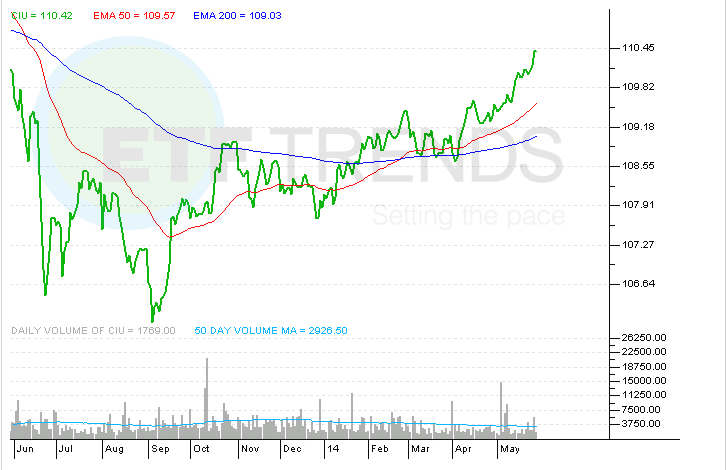
One option to consider among intermediate bond ETFs is the iShares Intermediate Credit Bond ETF (NYSEArca: CIU). The $5.7 billion ETF garners an overweight rating from S&P Capital IQ.
CIU holds corporate bonds with remaining maturities of less than 10 years and the ETF’s weighted average maturity is 4.79 years. With a 30-day SEC yield of 1.94%, CIU has an effective duration of 4.24 years, according to iShares data.
“We believe CIU offers a strong combination of risk-reward traits to investors that desire to incur some credit and duration risk, but not reach too far out on either spectrum compared to high-yield or long-duration ETFs. We believe this is evident in our ranking assessments for CIU, where most of the inputs are neutral, but the ETF earns a top overall ranking of Overweight from S&P Capital IQ,” said Rosenbluth in the note.
Credit risk is not a primary concern with CIU as roughly 58% of the ETF’s holdings are rated A- or higher by Standard & Poor’s. CIU is not a pure corporate bond ETF because it can allocate up to 20% of its weight to non-corporate issuers.
For example, super national issues from the International Bank for Reconstruction and sovereign from Turkey, among others, are found among the ETF’s holdings. [Spotlight on Intermediate Credit Bonds]
“Overall, S&P Capital IQ believes that iShares Intermediate Credit Bond ETF offers a favorable combination of risk-reward characteristics and warrants a look from investors who ascribe to the consensus view that while Fed tapering will continue, bond yields will remain in a tight range in the near term,” added Rosenbluth.
iShares Intermediate Credit Bond ETF
Tom Lydon’s clients own shares of TLT.