If reading market tea leaves truly is a fruitful activity, then investors might do well to pay attention to the recent action in some Europe exchange traded funds, particularly with the European Central Bank set to meet on June 5.
Consider the following factoids that point to rampant expectations of ECB easing that could weaken the euro:
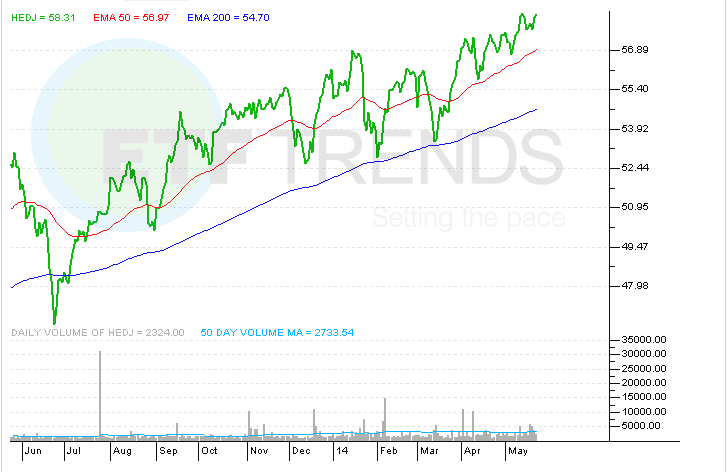
On Thursday, just 24 ETFs made new all-time highs. The WisdomTree Europe Hedged Equity Fund (NYSEArca: HEDJ) was one of those funds. Since the start of the second quarter, HEDJ is up 2.2%. That may not sound like much, but it is almost 60 basis points better than the unhedged Vanguard FTSE Europe ETF (NYSEArca: VGK). [These ETFs Say ECB Will Ease]
Although VGK is one of this year’s most prolific asset gatherers, HEDJ has not been a slouch on that front. The ETF topped $1 billion in assets in early April and now has $1.38 billion in assets under management. Translation: HEDJ has grown 38% in six weeks. [Hedge Europe ETF Tops $1B in Assets]
Another example of the rush to prepare for potential ECB easing is the iShares Currency Hedged MSCI Germany ETF (NYSEArca: HEWG). We excluded HEWG from the list of ETFs that made all-time highs Thursday because the fund is not yet four months old.
What cannot be refuted is this: HEWG’s average volume before Thursday was 324 shares, but 1.88 million shares changed hands in the fund yesterday. The ETF had $2.46 million in assets as of May 21. Expect to see that number in the area of $30 million to $32 million or higher in the coming days.
A case can be made that the db X-trackers MSCI Germany Hedged Equity Fund (NYSEArca: DBGR), the oldest of three Germany hedged ETFs, has been pricing in the possibility of ECB easing all year. DBGR has doubled in size since the start of 2014. [A Different Way to Germany]
DBGR and the rival WisdomTree Germany Hedged Equity Fund (NasdaqGM: DXGE) are up an average of 3% this year.
The db X-Trackers MSCI Europe Hedged Equity Fund (NYSEArca: DBEU)has $116.5 million in assets, almost 92% of which has come into the fund this year. DBEU allocates almost 43% of its combined weight to the U.K. and Switzerland and another combined 6.6% to Sweden and Denmark. None of those countries use the euro.
That means DBEU is exposed to two developed market currencies that arguably overvalued – the euro and the British pound. With the U.K. economy improving, it appears unlikely the Bank of England will take steps to actively weaken the pound, but if sterling does decline with British equities remaining firm, DBEU is among the ETFs that would benefit. [A Falling Pound Would Lift These ETFs]
WisdomTree Europe Hedged Equity Fund
Tom Lydon’s clients own shares of HEDJ.