Emerging markets exchange traded funds have rebounded a bit this year with the Vanguard FTSE Emerging Markets ETF (NYSEArca: VWO) and the iShares MSCI Emerging Markets ETF (NYSEArca: EEM), the two largest emerging markets ETFs by assets, higher by an average of 12% over the past 90 days.
Impressive rallies have been notched by a multitude of single-country ETFs tracking developing economies, but most China funds have been left out in the cold.
“Analysts project further weakening of the Chinese economy, spelling more trouble, we think, for its domestic stock market in the months immediately ahead. Already ranked the 11th worst-performing equity market thus far this year by Bloomberg, the Shanghai exchange may not be generating double-digit losses comparable to those of its counterpart in Moscow,” said S&P Capital IQ in a new research note. “Yet, the former could be competing with the latter for the worst ranking in the coming months if the government in Beijing continues to resist pressure for implementing some form of stimulus to bolster economic activity.”
Year-to-date, the iShares China Large-Cap ETF (NYSEArca: FXI), the largest China ETF, has lost 9.6%. Among the four major single-country ETFs tracking BRIC nations, only the Market Vectors Russia ETF (NYSEArca: RSX) has been worse. [Russia ETFs Tumble After S&P Downgrade]
“Denominated in U.S. dollars, cumulative year-to-date losses totaled 7.4% and 5.9% for the Shanghai and Shenzen exchanges, respectively. Hong Kong’s Hang Seng index slumped 5% since the beginning of the year. Although China’s real GDP growth will probably slow to 7.5% in 2014 according to S&P Capital IQ, restrained fiscal and counter-inflationary monetary policies should proceed to dampen enthusiasm for domestic stocks,” said S&P Capital IQ.
The research firm rates the SPDR S&P China ETF (NYSEArca: GXC). Still, other Asian markets have delivered for investors this year. [A Bullish View on Some Asia ETFs]
“South Korea’s economy is growing strongly despite its presumed expensiveness vis-a-vis its neighbor to the west. Philippines, Indonesia, Taiwan, and even Hong Kong–despite its exposure to China–all offer options for diversification in view of an improving outlook for economic activity in each country,” said the research firm.
Indonesia, Southeast Asia’s largest economy, has seen its equity market bounce back with a vengeance due to the strengthening rupiah and narrowing current account deficit.
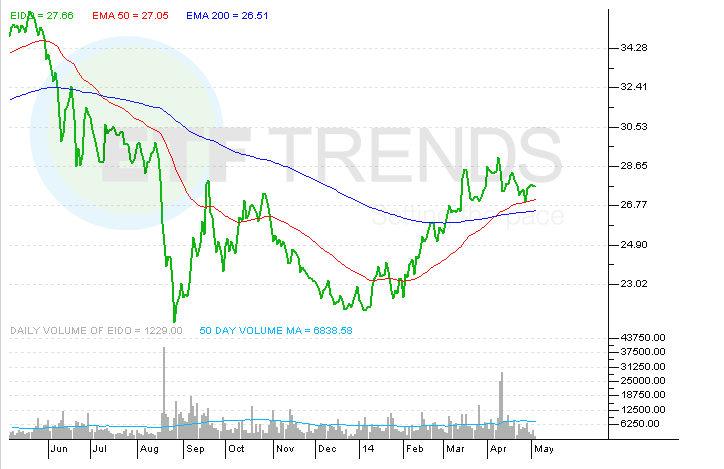
Year-to-date, the iShares MSCI Indonesia ETF (NYSEArca: EIDO) and the Market Vectors Indonesia Index ETF (NYSEArca: IDX) are up an average of 20.5%. Political issues are at play and investors should monitor the ability of Governor Joko Widodo to win this year’s presidential election. S&P Capital IQ rates EIDO overweight. [Polls Lift Indonesia ETFs]
Investors searching for more docile emerging markets fare can turn to an ETF like the iShares MSCI Taiwan ETF (NYSEArca: EWT). Unlike many its emerging market country-specific rivals, EWT is not heavily allocated to the financial services or energy sectors.
Rather, the $2.99 billion ETF sports an almost 57% weight to technology stocks. More importantly for the conservative investor, EWT has a beta of just 0.54 and a three-year standard deviation of 16.7%, nearly 300 basis points below the standard deviation on EEM. S&P Capital IQ rates EWT overweight.
iShares MSCI Indonesia ETF
Tom Lydon’s clients own shares of EEM.