Amid reports that pro-Russia militant groups remain active in Eastern Ukraine, Russian stocks and exchange traded funds slid Monday, extending a tumultuous run for assets with exposure to one of the largest emerging economies.
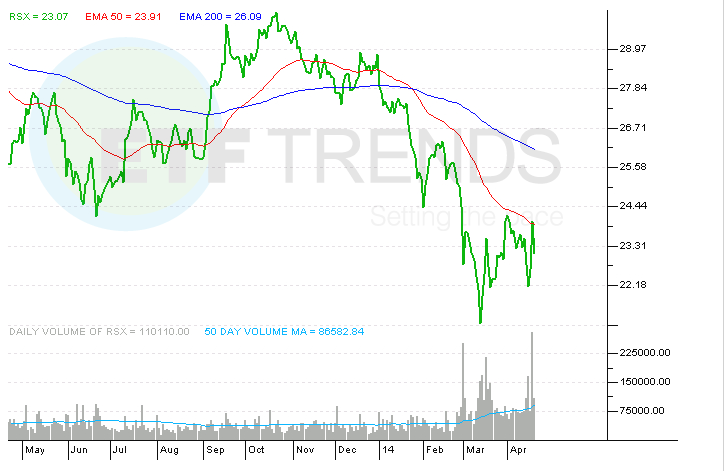
The Market Vectors Russia ETF (NYSEArca: RSX), the largest and most heavily traded Russia ETF, fell 3.8% on volume that was nearly 45% above the daily average while the rival iShares MSCI Russia Capped ETF (NYSEArca: ERUS) lost 3.4%. Although the two Russia ETFs are up an average of 4% over the past month, there is mounting evidence investors are looking for less volatile pastures. [Investors Nervous About Russia ETFs]
After hauling in a record $574 million last month, RSX saw outflows of $42 million on April 16 and 17, Alexandria Baca reports for Bloomberg. That represents a recent acceleration of outflows from the fund as net departures from RSX stand at about $6.4 million for April. Since April 1, investors have pulled $29.4 million from ERUS.
RSX “traded at 4.4 percent above its net asset value on April 17 as investors bought the fund on U.S. exchanges when news about the Ukraine accord in Geneva came out after the close of trading in Moscow,” according to Bloomberg. That was the biggest gap to NAV in four years. That premium narrowed Monday as RSX fell back inline with its NAV.
Russia is home to some of the lowest equity valuations in the developing. Last month, Russia’s benchmark Micex was trading at 4.8 times earnings, roughly half the P/E ratio seen on the MSCI Emerging Markets Index at the time. [Are Russia ETFs Finally Cheap Enough?]
Russia is also the second-largest emerging markets dividend payer behind China (RSX yields 3.1%), but investors lured by dividends and compelling valuations must deal with volatility that is elevated even by the standards of emerging markets. [The Case of Russia ETF Flows]
RSX’s three-year beta against the S&P 500 is almost 1.8 with a three-year standard deviation of 29.55% and a Sharpe ratio of -0.51, according to Market Vectors data. RSX’s three-year standard deviation is 1,000 basis points higher than that found on the iShares MSCI Emerging Markets ETF (NYSEArca: EEM).
Market Vectors Russia ETF
ETF Trends editorial team contributed to this post.