As bond investors begin to grapple with the idea of a rising rate environment, asset managers are engineering exchange traded funds that try to negate, and even profit off, rate risk.
Companies like BlackRock (NYSE: BLK) and WisdomTree Investments (NasdaqGS: WETF) have launched or filed for nearly 20 ETFs that help insulate investors from rising interest rates. [iShares Plans Active Interest Rate Hedged Bond ETFs]
These new types of zero duration or negative duration ETFs hold long-term bonds, but they will short Treasuries or Treasury futures contracts to hedge against potential losses if interest rates rise – bond prices have an inverse relationship to interest rates, so rising rates corresponds with falling bond prices.
Negative duration ETFs, on the other hand, tries to profit off a rising rate environment by heavily using short contracts to capitalize on falling bond prices if rates do rise. However, due to the more aggressive nature of this strategy, these types of ETFs will underperform if rates fall.
Duration is a measure of a bond fund’s sensitivity to interest rates, so a fund with a higher duration would exhibit a greater sensitivity to changes in rates. For example, a bond fund with a 3.5 year effective duration would decline about 3.5% if interest rates were to increase 1%. In contrast, a fund with an effective duration of 0 year would not be affected by rising rates, and an ETF with a negative duration would potentially see greater returns if rates increased.
WisdomTree has launched a suite of zero-duration and negative-duration bond funds, including the WisdomTree Barclays U.S. Aggregate Bond Zero Duration Fund (NYSEArca: AGZD), WisdomTree Barclays U.S. Aggregate Bond Negative Duration Fund (NYSEArca: AGND), WisdomTree BofA Merrill Lynch High Yield Bond Zero Duration Fund (NYSEArca: HYZD) and WisdomTree BofA Merrill Lynch High Yield Bond Negative Duration Fund (NYSEArca: HYND). The ETFs provide access to investment-grade and speculative grade debt with a hedge against rising interest rates. [WisdomTree Launches 6 ETFs for a Changing Rate Environment]
AGZD has a duration of 0.06 and a 1.8% 30-day SEC yield. AGND has a -4.95 duration and a 1.67% 30-day SEC yield. HYZD has a -0.11 duration and a 3.81% 30-day SEC yield. HYND has a -7.07 duration and a 3.79% 30-day SEC yield.
“With interest rates at historic lows, the values of traditional fixed income portfolios may be vulnerable to losses should rates increase in the future,” Rick Harper, WisdomTree’s Head of Currency and Fixed Income, said in a note. “The WisdomTree Rising Rates ETFS allow fixed income investors to maintain traditional allocations while providing greater flexibility to manage interest rate risk.”
ProShares recently launched a similar strategies. For instance, the ProShares Investment Grade-Interest Rate Hedged ETF (BATS: IGHG) and the ProShares High Yield Interest Rate Hedged ETF (BATS: HYHG) are comprised of long positions in USD-denominated corporate bonds issued by U.S. and foreign companies and take short positions in U.S. Treasury notes. IGHG has a -0.03 duration and a 3.53% 30-day SEC yield while HYHG has a -0.17 duration and a 4.58% 30-day SEC yield. [Alternative ETFs Mitigate Rising Rates Risk]
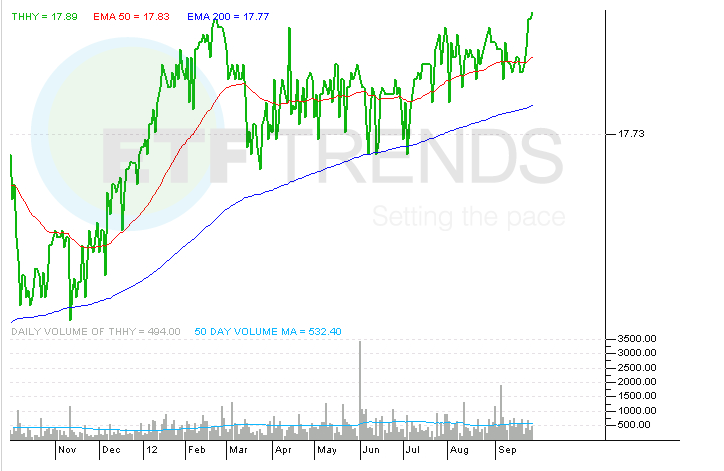
The Market Vectors Treasury-Hedged High Yield Bond ETF (NYSEArca: THHY) also provides another option to access high-yield, junk bonds. Specifically, the fund’s underlying index employs a type of long/short strategy where it will go long junk bonds and short 5-year Treasury bonds to hedge against adverse movements in interest rates. THHY shows a -0.52 duration and a 3.81% 30-day SEC yield. [Market Vectors Launches Hedged Junk Bond ETF]
Market Vectors Treasury-Hedged High Yield Bond ETF
For more information on fixed-income assets, visit our bond ETFs category.
Max Chen contributed to this article.