Yesterday we spoke about a Revenue Weighted alternative to market cap indexed Small Cap ETFs, RWJ (RevenueShares Small Cap, Expense Ratio 0.54%) and today we are keeping a similar focus in covering three other “fundamental” or “quantitative” index methodologies in the U.S. Small Cap Equity space.
The largest of these funds in terms of assets under management currently is DES (WisdomTree Small Cap Dividend, Expense Ratio 0.38%), which has raised approximately $1.07 billion since its 2006 inception. The strategy tracks the proprietary WisdomTree SmallCap Dividend Index, which attempts to zero in on small cap stocks that historically have paid dividends. Top holdings currently are (VGR, CPWR, UIL, LXK, and WGL).
The ETF itself holds 691 individual equities, so it is rather well diversified when compared to cap weighted benchmark ETFs. PowerShares has had visible success with their fundamentally weighted Small Cap strategy, PRFZ
(PowerShares FTSE RAFI U.S. 1500 Small-Mid Portfolio, Expense Ratio 0.39%) which is another alternative to market cap and has raised $971 million since its 2006 inception.
Like other RAFI products, using proprietary screens, the index methodology hones in on 1500 individual Small and Mid-Cap stocks. It is worth noting that although this fund “leans” small-cap, it is purposely not designed to be “Small-Cap exclusive” in terms of its portfolio holdings and exposure, and for comparison purposes, these differences should be noted when comparing head to head with market cap weighted Small Cap index ETFs for example.
The four fundamental metrics that the RAFI strategy zeroes in on when selecting and ranking the holdings are book value, cash flow, sales, and dividends, and we note the presence of “dividends” again here, given we just mentioned the WisdomTree Small Cap dividend strategy.
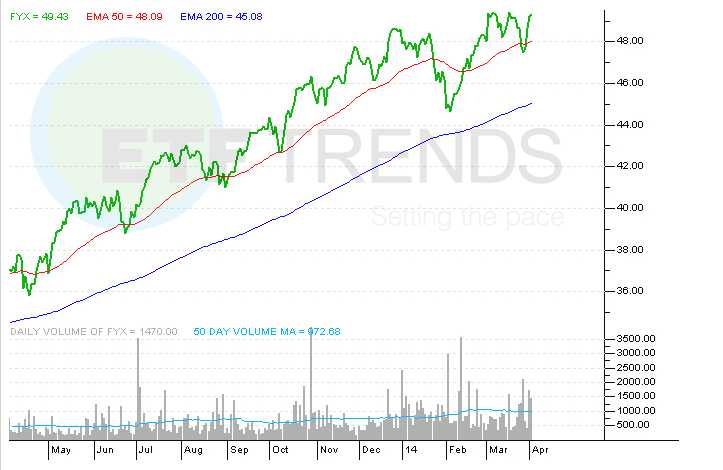
First Trust has had success recently with FYX (First Trust Small Cap Core AlphaDEX, Expense Ratio 0.70%), with this fund pulling in >$275 million in the trailing one year period alone (it is now a $584 million fund).
Employing the AlphaDEX strategy which we have covered countless times in the past several years, this fundamentally weighted approach hones in on the following metrics: “3, 6, 12 month price appreciation, Sales To Price, One Year Sales Growth” where these are characterized as “Growth” factors according to fund literature while on the “Value” side, “Book Value To Price, Cash Flow To Price, and Return On Assets” are screened for.
In pure performance terms since inception, DES has greatly lagged cap weighted benchmarks IJR and IWM, but perhaps this is expected to some degree given the fund’s focus on dividend payers in the Small Cap space. On the
other hand, PRFZ and FYX have outpaced cap-weighted benchmarks since inception, and thus this has certainly not hurt the asset raising efforts.
The underlying point of these analyses is to simply point out the existence of non-cap weighted U.S. Small Cap ETF strategies and how they can be used in conjunction or as alternatives to existing cap weighted ETF holdings, if not actively managed Small Cap mutual funds.
First Trust Small Cap Core AlphaDEX Fund
For more information on Street One ETF research and ETF trade execution/liquidity services, contact Paul Weisbruch at pweisbruch@streetonefinancial.com.
Street One Financial is an educational/research firm utilizing the Broker Dealer services of GWM Group Inc (RLCC) a FINRA registered Broker/Dealer. All trades are executed through GWM Group (RLCC) and cleared by Fidelity (NFS)DTC number 0226. Street One Financial LLC makes available products and services offered by GWM Group Inc., a registered broker-dealer and Member Securities Investor Protection Corporation (SIPC), Investing in securities involves risks, and there is always the potential of losing money when you invest in securities.