It has been one of the leading contributors to S&P 500 dividend growth since the end of the financial crisis, but the technology sector still is not thought of by investors as a dividend destination on par with the likes of consumer staples, health care and other sectors.
Perhaps it is because the notion of dependable, growing dividends from technology, the largest sector weight in the S&P 500, is still a new phenomenon. Whatever the reason, tech is only starting to get some dividend attention and deservedly so. At the end of last year, the 44 stocks in the S&P 500 Information Technology Index had an average yield of 1.64%, according to CNBC.
That was up about 70 basis points from the end of 2012 and remember the PowerShares QQQ (NasdaqGM: QQQ), the NASDAQ 100 tracking ETF, has a trailing 12-month yield of 1.43%. That is up from around 0.9% right before the tech bubble burst earlier this century. [QQQ’s Quiet Rally]
As CNBC notes, tech dividends are low compared to high-yielding sectors like utilities, but that also means there is room for payout growth. Some tech ETFs have benefited from Apple’s (NasdaqGS: AAPL) as the second-largest U.S. dividend payer in dollar terms behind Exxon Mobil (NYSE: XOM). For example, the Technology Select Sector SPDR (NYSEArca: XLK) and the iShares U.S. Technology ETF (NYSEArca: IYW) have an average yield of 1.35%. Apple is 13.6% of XLK’s weight and 16.1% of IYW.
Investors hunting for exposure to tech payouts via dividend ETFs need to do some homework. Several of the largest U.S. dividend ETFs use dividend increase streaks as part of their screening methodology, but because tech dividend growth has only escalated in the past several years, the sector is lightly represented in some of those ETFs. The three largest U.S. dividend ETFs by assets have a COMBINED weight to tech of less than 12%. [Fight Inflation WIth Dividend Growth ETFs]
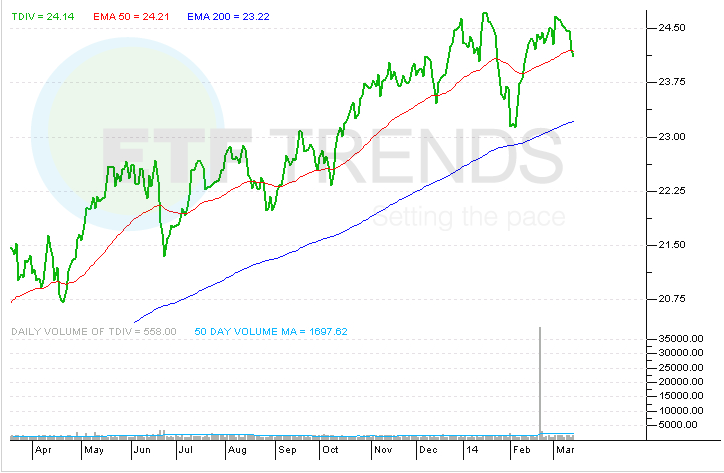
Tech’s lack of representation in traditional dividend ETFs has opened the door for ETFs such as the First Trust NASDAQ Technology Dividend Index Fund (NasdaqGM: TDIV) to gain traction.
TDIV turns two in August and already has more than $400 million in assets. Plus, its trailing 12-month yield of 2.32% is decent by the standards of tech ETFs. Dow components Intel (NasdaqGS: INTC), IBM (NYSE: IBM), Cisco (NasdaqGS: CSCO) and Microsoft (NasdaqGS: MSFT) combine for over 32% of TDIV’s weight. Constituent companies are required to yield at least 0.5% and have paid a dividend in the past year. [Digital Dividends in an ETF]
Some new dividend ETFs are offering increased tech exposure compared to older payout funds. For example, the WisdomTree U.S. Dividend Growth Fund (NasdaqGM: DGRW) features tech as its largest sector weight at 20.2%. Four tech stocks, including Apple, are found among DGRW’s top-10 holdings. [Dividend Growth With ETFs]
DGRW has over $102 million in assets and is up almost 10% since its May 2013 debut. DGRW pays its dividend on a monthly basis.
The First Trust NASDAQ Rising Dividend Achievers ETF (NasdaqGM: RDVY), which debuted in January, has a 24.2% weight to the tech sector. RDVY does not focus on dividend increase streaks, but to be eligible for inclusion in the ETF, a stock’s dividend over the trailing 12 months must be larger “than the dividend paid in the trailing twelve-month period three and five years prior,” according to First Trust.
RDVY also screens for companies with cash/debt ratios in excess of 50% while excluding those firms with payout ratios in excess of 65%.
First Trust NASDAQ Technology Dividend Index Fund
Tom Lydon’s clients own shares of Apple, Cisco, Intel, Microsoft and QQQ.