There are exchange traded funds that, by their very design, are true momentum funds. Biotechnology, Internet and social media ETFs are prime examples.
Then there are more conservative, but still rewarding plays on momentum strategies. ETF sponsors have sliced and diced the smart beta concept into ever finer points and one that has gained prominence is the idea of momentum-based funds.
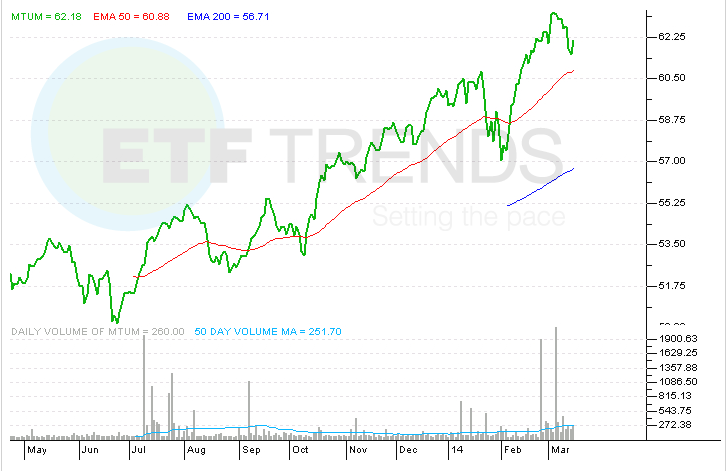
The iShares MSCI USA Momentum Factor ETF (NYSEArca: MTUM) falls into this category, but the fund has not done much falling. Since debuting 11 months ago, MTUM has gained more than 23%. On that basis alone MTUM stands as one of the more successful new ETFs to debut in 2013, but there is more to the story.[A Good Year to be a New ETF]
MTUM was one of several ETFs iShares developed at the request of the Arizona State Retirement System, which seeded each ETF with $100 million. Having one investor chip in $100 million right off the bat is a nice advantage for any ETF, but the trick is accumulating more assets after. MTUM has done that with aplomb as evidenced by a current assets under management tally of $244.4 million. [New Factor ETFs Burst on the Scene]
As for MTUM’s credibility as a momentum play, it is legitimate. Health care, consumer discretionary and technology names combine for over two-thirds of the ETF’s weight. Facebook (NasdaqGS: FB), Google (NasdaqGSL GOOG), Gilead (NasdaqGS: GILD), Amazon (NasdaqGS: AMZN) and Celgene (NasdaqGS: CELG), all momentum stocks, are MTUM top-10 holdings.
A P/E ratio of 33.4 and a price-to-book ratio of 7.2, according to iShares data, solidify MTUM’s status as a momentum fund.
Here is the secret to MTUM’s momentum factor: “At each rebalance, a risk-adjusted price momentum is calculated (defined as the excess return over the risk-free rate divided by the annualized standard deviation of weekly returns over thepast 3-years) for each security in the parent index over the trailing 6- and 12-month time period. The 6- and 12-month risk-adjusted price momentum scores are then standardized at +/-3 standard deviations and the standardized z-scores are translated into an average momentum score. Approximately 100-150 securities with the highest momentum scores are selected for inclusion in the Underlying Index,” says iShares.
None of the above means MTUM is bereft of stocks with value tilts. For example, Dow components Johnson & Johnson (NYSE: JNJ), Boeing (NYSE: BA) and 3M (NYSE: MMM) are found among the ETF’s top-10 holdings not because they are momentum names in the way most investors perceive momentum, but because those stocks were exhibiting strong price action upon addition to the fund.
iShares MSCI USA Momentum Factor ETF
Tom Lydon’s clients own shares of Amazon, Facebook and Google.