Exchange trade funds tracking Russia are plunging Monday after the country invaded Ukraine. Stocks on Russia’s benchmark MICEX Index plunged earlier Monday, falling to levels not seen the darkest days of the Lehman Brothers crisis and the country’s 2008 conflict.
U.S. officials stated Russian forces have full control of the Crimean peninsula and the Wall Street Journal reported that Russia has seized key border posts. “The Russians special forces have taken control of several border units using brutal physical force and threat of arms and fear-mongering,” the Journal reported, citing a statement from Ukraine’s border service.
News of the escalating conflict has the Market Vectors Russia ETF (NYSEArca: RSX), the oldest and largest Russia ETF, trading lower by 7.7% on volume that is already more than two and a half times the daily average. RSX is trading around $22.50 at this writing, a level the ETF has not closed below since early June 2012.
The iShares MSCI Russia Capped ETF (NYSEArca: ERUS) is off almost 9% on volume that is nearing double the average turnover. Energy and financial services names, a combine 54% of RSX’s and 71% of ERUS’ weight, are being hammered on news of the Ukraine conflict.
“Stocks in Russian gas giant Gazprom — which has a huge contract to export gas to Ukraine as well as banking interests in the country — fell 12.50 percent. Russia’s biggest lender Sberbank was down 15.57 percent,” reports Agence France Presse.
Gazprom and Sberbank combine for 30.4% of ERUS, but just 15.5% of RSX. The SPDR S&P Russia ETF (NYSEArca: RBL) is lower by 9.3%. Gazprom and Sberbank combine for almost 27% of RBL’s weight. Like ERUS, RBL is flirting with all-time lows Monday.
Further pressuring Russia ETFs, none of which feature hedged currency exposure, is the weakening ruble. The Russian currency has faltered to record lows against the U.S. dollar even after the Russian central bank surprisingly raised is one-week repurchasing rate to 7% from 5.5%.
The Black Monday for Russia ETFs will force already low valuations even lower. Russian stocks typically traded at discounts to the broader emerging markets universe, but last year, Russian equities became deeply discounted to their historical norms. [Worst Equity Markets by Single-Country ETFs]
Conflict with Ukraine could prove damaging to Russia’s efforts to lure more investors, something the country has attempted to do by becoming one of the more compelling dividend destinations in the developing world. Several top-10 holdings in the aforementioned ETFs have recently boosted their payouts. [Russia Looks to Assert Dividend Dominance]
The specter of capital flight at the hands of foreign investors cannot be overlooked as it pertains to Russian stocks and ETFs. Andrei Kuznetsov, strategist at Sberbank “estimates about 70 percent of Russian freely traded shares is controlled by foreigners and a big portion of foreigners – about 40 percent – is from the United States,” Reuters reported.
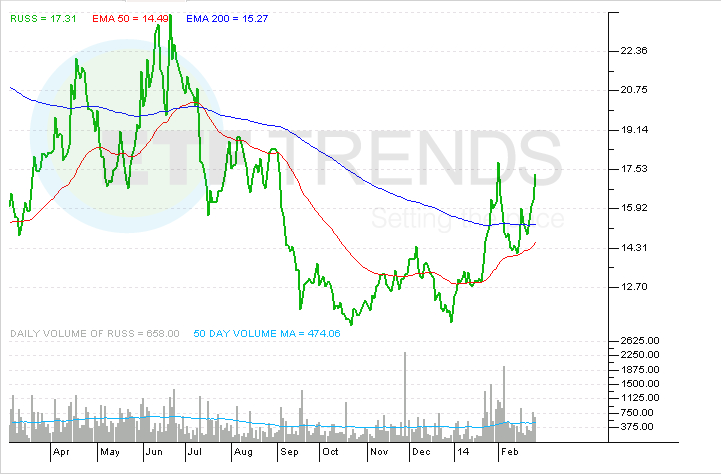
There is evidence some traders were prepared for the conflict in Ukraine to take a turn for the worse. The Direxion Daily Russia Bear 3x Shares (NYSEArca: RUSS) ended February as Direxion’s top-performing triple leveraged bearish ETF and saw modest creation activity last Friday, according to issuer data.
Direxion Daily Russia Bear 3x Shares