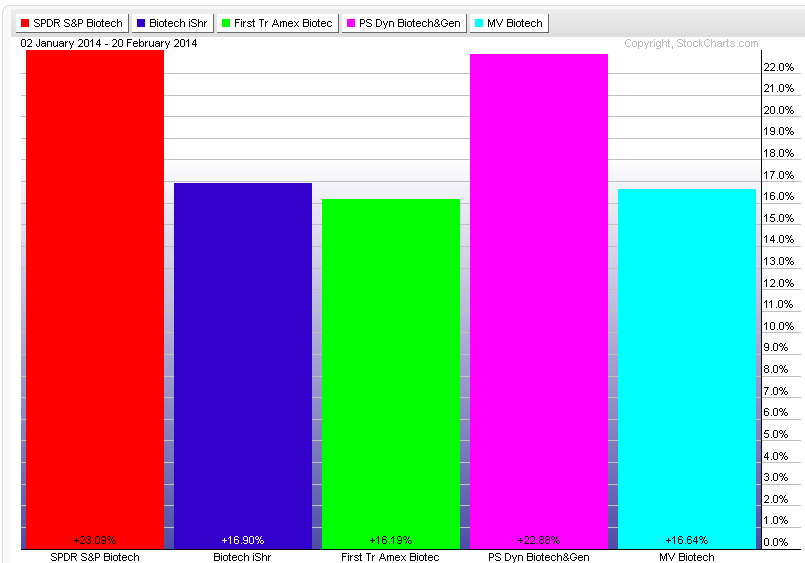
There are five biotechnology exchange traded funds on the market today. Confirming just how strong the sub-sector has been this year three of those ETFs – the First Trust NYSE Arca Biotechnology Index Fund (NYSEArca: FBT), the Market Vectors Biotech (NYSEArca: BBH) and the iShares Nasdaq Biotechnology ETF (NasdaqGS: IBB) – have year-to-date gains ranging from 16.2% to 17% and they look laggards compared to the leader.
The leader is the SPDR S&P Biotech ETF (NYSEArca: XBI), which is up 23.1%. XBI’s leadership, which is getting a run for its money from the PowerShares Dynamic Biotechnology & Genome Portfolio (NYSEArca: PBE), highlights the importance of investors of investors not assuming all biotech ETFs are the same simply because “biotech” is in the funds’ names. [One Biotech ETF Standout]
There are obvious reasons XBI is wearing the crown this year among biotech ETFs.
“XBI has outperformed its peers YTD as well, which is attributable to the S&P Select Industry Index’s equal weighting methodology. Here are some more specific thoughts,” said State Street Global Advisors Vice President Dave Mazza in an interview with ETF Trends.
XBI’s equal weight methodology has already proven advantageous this year. January 9th proves as much. That was the day shares of Intercept Pharmaceuticals (NasdaqGM: ICPT) nearly quadrupled, helping XBI to a 7% gain. At the time XBI’s weight to that stock was just 1.6%, but that was well above Intercept’s weight in rival biotech ETFs. The stock is now XBI’s largest holding with an allocation of 6.9%. [The One ETF Benefiting From the Intercept Pharma News]
New drug approvals and positive clinical trial are just two pieces of the puzzle for any biotech ETF, XBI included. Another pivotal piece is mergers and acquisitions, a scenario XBI is levered to by virtue of its more intense focus on small- and mid-cap biotech names. [Small Stocks Could Mean Big Gains for This Biotech ETF]
“Elevated M&A activity and year-over-year earnings growth for the biotech industry of 96% ending Q3 2013 versus 3% for the S&P 500 Index, have been major drivers of strong returns,” said Mazza. “Patent protection on several high-profile and high-profit margin drugs are set to expire in the next couple of years, allowing competing pharmaceutical companies to make lower-priced generic versions. This threat is driving the large pharma companies to acquire or enter partnerships with biotech companies that have strong R&D pipelines. This M&A activity is boosting industry valuations, as acquirers have paid hefty takeover premiums for biotech shares.”
Biotech’s “Big Five” – Amgen (NasdaqGM: AMGN), Biogen (NasdaqGM: BIIB), Celgene (NasdaqGM: CELG), Gilead (NasdaqGM: GILD) and Regeneron (NasdaqGM: REGN) – dominate ETFs like IBB and BBH. None of those stocks are even top-10 holdings in XBI.
If there is a downside to the ongoing surge in biotech stocks and ETFs it is that the surge has prompted talk of a bubble bursting at the hands of frothy valuations.
The concern is legitimate with biotech trading at twice its historical multiple, but XBI has delivered superior returns relative to some noteworthy and pricy growth stocks. For example, since the start of 2013, XBI has offered double the returns of Amazon (NasdaqGM: AMZN). [Health Care ETFs Deal With High Valuations]
“With valuations at current levels and the recent number of IPOs biotechs may look to be bubbly territory to some, but investors may want to remember that the industry is driven by sector-specific factors including a powerful R&D pipeline, extremely high profit margins and favorable pricing power,” said Mazza.