Following Monday’s tumbles, scores of diversified emerging markets exchange funds are saddled with double-digit year-to-date losses. Each of the 10 worst non-leveraged ETFs to this point in 2014 are emerging markets funds.
Several of those ETFs are hampered by similar traits. They track commodities-intensive countries that are homes to slumping currencies, are mired in debt denominated in a strengthening foreign currency like dollars and are home to current account deficits.
That is to say if emerging markets ETFs ever bounce back, investors would do well to play that bounce with funds tracking account surplus nations. “At times of rising market volatility, investors seek out safer assets such as cash or US treasuries. Those emerging market countries with the greatest external financing requirements have the most to lose as this fickle capital heads for the exit,” according to a Citigroup note posted by ValueWalk.
Indeed, the list of the 10 worst ETFs is littered with some funds that do track account deficit countries, such as Brazil and Turkey, two members of the infamous Fragile Five, or BIITS, group. [Bad Things Happening in Emerging Markets]
Citi’s research points out that going back to 1995, a basket of emerging markets surplus countries has easily outpaced a basket of account deficit counterparts. Still, the surplus is no guarantee of positive returns for ETFs. Just look at Russia, which has a surplus. Two of the 10 worst ETFs this year are Russia funds. China has a surplus as well, but the iShares China Large-Cap ETF (NYSEArca: FXI) has plunged 12% year-to-date.
Some of the most conservative, lower beta single-country emerging markets ETFs are the funds that track account surplus countries, but that has been far from a guarantor of success in 2014. All it has meant is less bad. For example, Taiwan is an account surplus and a low beta emerging market to boot, but the iShares MSCI Taiwan ETF (NYSEArca: EWT) is off 8% this year.
South Korea, Asia’s fourth-largest economy, is running record surpluses and has one of the most impressive government balance sheets in the developing world. That has not stopped the iShares MSCI South Korea Capped ETF (NYSEArca: EWY) from sliding 11.1%. Some of the major ETFs tracking India, a current account deficit country, have outperformed EWY. [Conservative EM ETFs Betray Investors’ Faith]
Last month, Malaysia reported its largest trade surplus in almost two years, but the iShares MSCI Malaysia ETF (NYSEArca: EWM) has dipped 9% this year.
There are glimmers of hope for the account surplus trade. For example, Indonesia, Southeast Asia’s largest economy, on Sunday reported its largest surplus in two years. The Market Vectors Indonesia ETF (NYSEArca: IDX) is off 4.4% year-to-date.
The Philippines has run a surplus every year for over a decade, indicating treatment of the iShares MSCI Philippines ETF (NYSEArca: EPHE) dating back to last year has arguably been harsh. EPHE’s 2014 loss is inline with IDX’s.
While that has been enough to make those ETFs noticeably less bad than the others mentioned here, Indonesia and the Philippines do need to see their currencies strengthen because the bulk of GDP in both nations comes by way of domestic demand. [Philippines ETF Tries to Stay Strong]
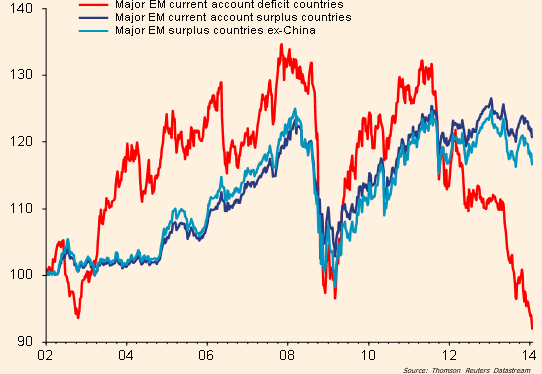
Chart Courtesy: Financial Times