Before getting too far into 2014, a prominent theme from 2013 is worth remembering: Share buybacks.
Members of the S&P 500 increased share buybacks by 8.6% during the third quarter to $128.2 billion up from the $118.1 billion spent on share repurchases during the second quarter, according to S&P Dow Jones Indices. [U.S. Buybacks Reach Highest Point Since 2007]
Put another way, the $445.3 billion spent on buybacks through the end of September 2013 could be used to “buy every single team in the NFL, NHL, NBA and Major League Baseball – all 122 franchises (estimated by Forbes to be worth a combined $77 billion) – five times and still have enough left over to buy out ESPN ($60 billion) to air all their games,” according to Josh Brown at The Reformed Broker.
In succinct terms, only Apple (NasdaqGM: AAPL) has a market cap north of $445 billion. Assuming the fourth-quarter share buyback number comes in close to the third quarter’s the total for 2013 will be close to a record. “Buybacks peaked at a whopping $589 billion in 2007, right before the market tanked,” reports Kopin Tan for Barron’s.
While that could prove to be an ominous sign (along with companies repurchasing shares at elevated prices), it is obvious U.S. firms love share buyback announcements. However, stock-picking on buyback news is far from a guarantor of success. Success in this case is defined as picking a buyback stock that tops the PowerShares Buyback Achievers Portfolio (NYSEArca: PKW).
PKW tracks the NASDAQ US BuyBack Achievers Index, which “is comprised of US securities issued by corporations that have effected a net reduction in shares outstanding of 5% or more in the trailing 12 months,” according to PowerShares. That means Apple, one of that largest buyers of its own shares, has not qualified for entry into PKW. [Illustrating Just How Strong the Buyback Is]
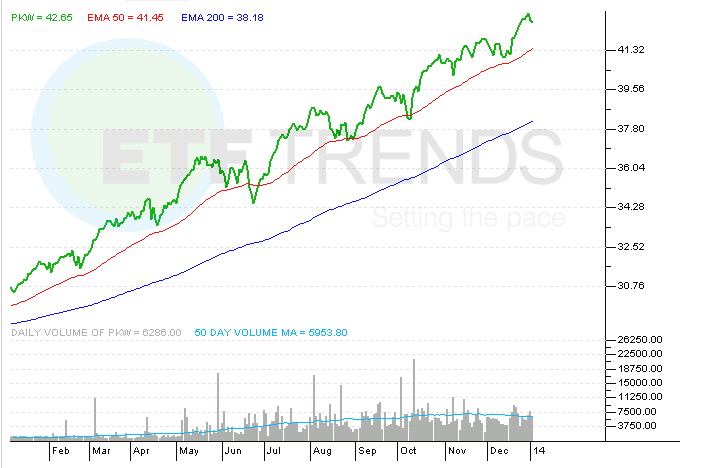
A more interesting (and important) point about PKW is that its 45.6% 2013 gain means the ETF outperformed many of its largest holdings. Here is the skinny: PKW is home to 196 stocks and we did NOT measure the ETF against all of those names. What we did do was compare PKW against the 23 holdings that account for 1% or more of its weight.
In 2013, PKW outpaced eight of its top-10 holdings, a group that combines for about 38% of the ETF’s weight. The outliers were Twenty-First Century Fox (NasdaqGM: FOX-A) and Viacom (NYSE: VIA-B). Overall, just nine of PKW’s holdings with a weight of at least 1% beat the ETF in 2013 while14 lagged the fund. The laggards group includes noteworthy names such as Amgen (NasdaqGM: AMGN), ConocoPhillips (NYSE: COP) and Oracle (NYSE: ORCL).
Utilities is the only one of the 10 GICS sectors not represented in PKW. Across the nine other sectors, only PKW’s largest staples and industrial holdings, Kroger (NYSE: KR) and Norfolk Southern (NYSE: NSC), beat the ETF last year. With the other seven sectors, investors would have had to go down to PKW’s second- or third-largest holdings to find a stock that outpaced the ETF.
Data also suggest PKW is delivering better returns than some of the largest share repurchasers currently not found in its lineup. In the third quarter, the five largest buybacks in dollar terms were conducted by Apple, Pfizer (NYSE: PFE), Halliburton (NYSE: HAL), Qualcomm (NasdaqGM: QCOM) and Johnson & Johnson (NYSE: JNJ), according to S&P Dow Jones Indices. Only Apple has outperformed PKW over that time.
PowerShares Buyback Achievers Portfolio
Tom Lydon’s clients own shares of Apple and Pfizer.