Investors had plenty of fun with financial services exchange traded funds in 2013. The Financial Select Sector SPDR (NYSEArca: XLF) surged 35.5%, but big things are expected from the S&P 500’s second-largest sector weight again in 2014.
“Specific to Financials, a steepening yield curve, faster loan growth and improving credit quality should boost EPS visibility for this S&P 500 Index sector,” said S&P Capital IQ in a new research note.
Speaking of boosting earnings, financial services look inexpensive compared to other sectors. Despite the surge in bank stocks last year and the sector’s reputation for being one of the better drivers of S&P 500 earnings growth, the group is not getting much respect in terms of 2014 earnings expectations. As of early December, financial services had the lowest 12-month forward P/E. At forward P/E of 12.7, financials are seen as less expensive than staples and utilities, among others. [Financials: The Rodney Dangerfield Sector]
S&P Capital IQ has strong buy or buy ratings (five or four stars) on 38 S&P 500 financial services names. That group includes Dow components American Express (NYSE: AXP) and J.P. Morgan Chase (NYSE: JPM) and BlackRock (NYSE: BLK), the world’s largest asset manager. BlackRock is also the parent company of iShares, the world’s largest ETF sponsor.
“Of the 46 U.S.-focused Financial ETFs that we cover, 14 earn a top overall ranking of Overweight,” said S&P Capital IQ. “In establishing a ranking, S&P Capital IQ uses a combination of holdings-based analysis, to assess the valuation and risk considerations of the stocks inside the ETF, and ETF-level analysis for the Technicals, volatility and costs. Most of the Overweight ranked ETFs in this sector score well for the attractiveness of the stocks inside, according to S&P Capital IQ STARS and/or S&P Fair Value.”
XLF, the largest U.S. sector ETF with $17.1 billion in assets under management, is one of the financial services ETFs to earn an overweight rating from S&P Capital IQ. J.P. Morgan and American Express are top-10 holdings in that ETF, combining for 11.4% of the fund’s weight. [Evidence That No One Loves Bank ETFs]
The Vanguard Financials ETF (NYSEArca: VFH) also earned an overweight rating from S&P Capital IQ. Wells Fargo (NYSE: WFC) J.P. Morgan and Bank of America (NYSE: BAC) combined for 17.8% of VFH’s weight at the end of November. VFH charges 0.19% per year, which is slightly above the 0.18% charged by XLF.
Against the backdrop of rising rates, ETFs holdings regional banks and insurance providers surged in 2013. With Treasury yields expected to keep climbing this year, regional banks and insurance firms that have seen profits hampered by low rates are expected to thrive. [Regional Bank ETFs Rally to Finish 2013]
S&P Capital IQ has a five-star rating on Hartford Financial (NYSE: HIG). That stock is a top-10 holding in the iShares U.S. Insurance ETF (NYSEArca: IAK). IAK allocates almost 12% of its weight to American International Group (NYSE: AIG), is home to $162.6 million in assets and also garnered an overweight rating from S&P Capital IQ.
S&P also rates the iShares U.S. Regional Banks ETF (NYSEArca: IAT) and the iShares U.S. Financial Services ETF (NYSEArca: IYG) overweight. IYG is a competitor to XLF and VFH as the former features many of the same holdings, though at different weights, as its SPDR and Vanguard rivals.
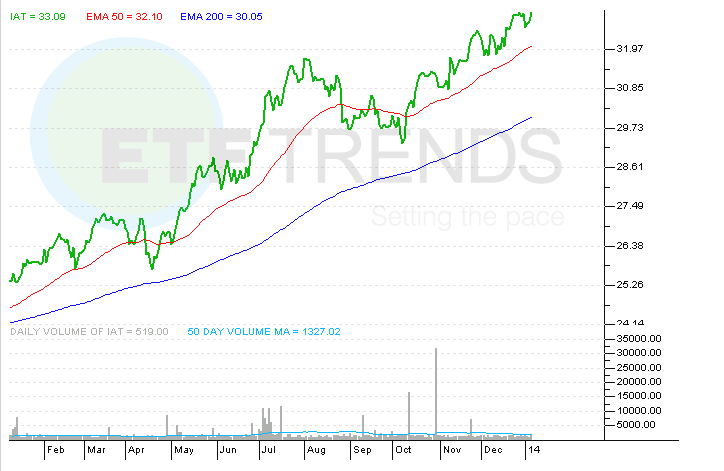
Although IAT’s name implies it is a regional bank ETF, the fund’s largest holdings are more accurately classified as super regionals. For example, US Bancorp (NYSE: USB) and PNC Financial (NYSE: PNC) combine for nearly 31% of IAT’s weight. The $490.3 million ETF is up 29.7% in the past year.
iShares U.S. Regional Banks ETF
Tom Lydon’s clients own shares of American Express.