These are halcyon days for U.S. dividend investors and the statistics affirm as much. In 2013, nearly 2,900 companies boosted their payouts.
“Net dividend increases rose $12.7 billion during the fourth quarter of 2013 for U.S. domestic common stock, compared to an $8.4 billion increase in the fourth quarter of 2012. 885 dividend increases were reported during the quarter, significantly lower than the tax incentivized 1,266 companies which raised dividends in 2012, but up 36.4% from the 649 companies which raised dividends in 2011,” according to S&P Dow Jones Indices. [Dividends Are Divine, but Payout Ratios Are Low]
The good news does not end there.
“A whopping $312 billion was paid out in dividends by S&P 500 companies, up 11% from in 2012. On a per share basis, after declining in 2009 to $22.41 as companies restored their balance sheets amid the financial crisis, dividends climbed back to approximately $35 per share in 2013,” according to a new research note from S&P Capital IQ.
Overall in 2013, there were 366 dividend increases in the S&P 500 compared to just 12 cuts, an impressive 30.5-to-1 ratio. S&P Capital IQ notes that financial services and consumer discretionary led all sectors with 79 and 53 dividends increases, respectively. Dividend boosters in those sectors included, Dow component J.P. Morgan Chase (NYSE: JPM) and Coach (NYSE: COH), both which carry five-star ratings from S&P Capital IQ.
Still, rising Treasury yields could crimp some dividend stocks and ETFs, making equity and fund selection increasingly important. “S&P Capital IQ has Buy or Strong Buy recommendations on 34 S&P 500 Index constituents that offer a dividend yield currently greater than the 10-year,” Treasury, said the research firm. Names in that group include Dow component Chevron (NYSEArca: CVX) and tobacco giant Lorillard (NYSE: LO), which S&P rates with five and four stars, respectively. [Top-Flight Dividend ETFs and Indices]
Dividend ETFs favored by S&P Capital include the largest payout fund, the Vanguard Dividend Appreciation ETF (NYSEArca: VIG). VIG tracks the NASDAQ Dividend Achievers Select Index, which requires companies have dividend increase streaks of at least 10 years for admission.
That means VIG is currently light on financial services and technology names, but the fund also features scant exposure to telecom and utilities stocks, indicating it is not overly vulnerable to rising interest rates. Top-10 holdings include Procter & Gamble (NYSE: PG), Pepsi (NYSE: PEP) and Exxon Mobil (NYSE: XOM). S&P Capital IQ rates VIG overweight.
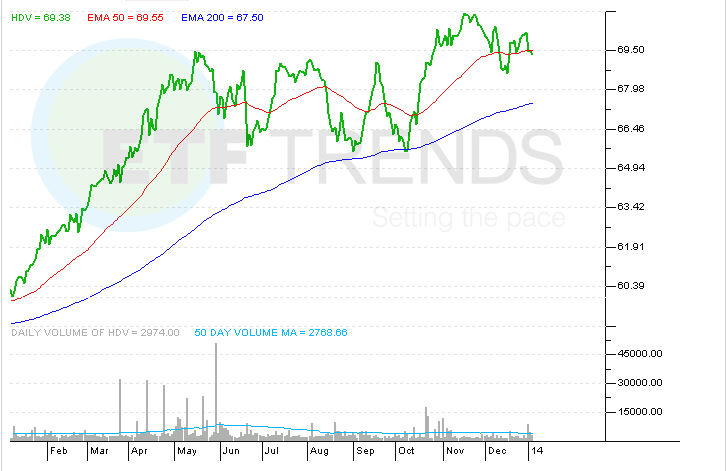
The research firm also has an overweight rating on the $3.1 billion iShares High Dividend ETF (NYSEArca: HDV). HDV is heavily allocated to Dow stocks as seven of its top-10 holdings are members of the blue chip index. Top holdings include AT&T (NYSE: T), Chevron and Johnson & Johnson (NYSE: JNJ).
With an almost 23% combined weight to utilities and telecom names, HDV does have some interest rate sensitivity but over a third of the fund’s weight goes to discretionary and tech stocks, two of the better performing sectors in rising rate environments. [Three Dividend ETFs That Soared in 2013]
S&P Capital IQ also rates the Schwab US Dividend Equity ETF (NYSEArca: SCHD) overweight. With an expense ratio of 0.07% per year, SCHD is the least expensive dividend ETF on the market and Charles Schwab clients can trade the fund-commission free.
Like VIG, SCHD has scant exposure to the telecom and utilities sectors, but industrials, technology and consumer discretionary stocks combine for nearly 42% of SCHD’s weight. SCHD also excludes rate-sensitive, yield-generating asset classes such as MLPs, REITs and preferred stocks from its lineup. SCHD’s top-10 holdings include Chevron, Home Depot (NYSE: HD) and Pepsi. [High Quality, Low Fees With This Dividend ETF]
iShares High Dividend ETF
Tom Lydon’s clients own shares of SCHD and Procter & Gamble.