Gold mining exchange traded funds, one of last year’s most widely followed and worst performing segments of the ETF universe, are getting plenty of attention again this year.
Fortunately for beleaguered investors, most of the news has been favorable. Helped by rising gold prices, which have translated to a 3.2% year-to-date gain for the SPDR Gold Shares (NYSEArca: GLD), mining stocks and ETFs have been notably better in 2014.
At various points last year, seven or eight of the 10 worst non-leveraged ETFs were related in some form to gold and silver and several of those funds were equity-based mining plays. This year, the Global X Gold Explorers ETF (NYSEArca: GLDX) and the Market Vectors Junior Gold Miners ETF (NYSEArca: GDXJ) each rank among the 10 best non-leveraged ETFs. GDXJ and GLDX were each reverse split last year due to tumbling share prices. [Gold Rebound Powers Mining Stocks]
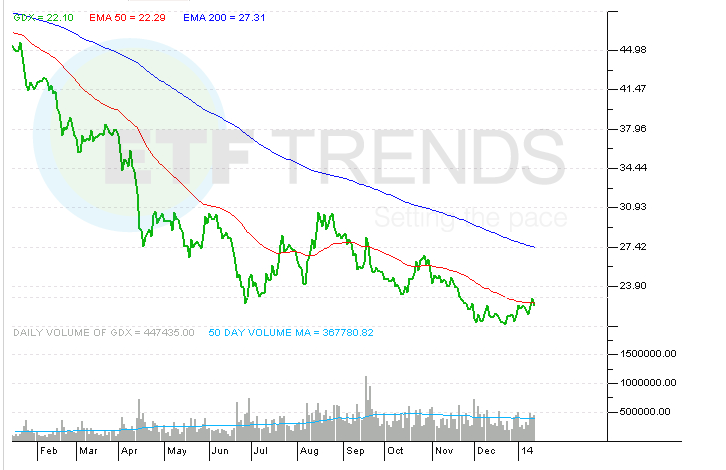
The Market Vectors Gold Miners ETF (NYSEArca: GDX), the largest gold mining ETF by assets, has gained nearly 6% since early December and has peaked above its 50-day moving average since for the first time since early November. [Little Love for Gold Miners ETF]
These embattled ETFs are not only benefiting from rising gold prices, but from an array of bullish calls. GDX gained a bull call in December as one market observer astutely pointed out that one year’s laggard sectors often turn into the next year’s leaders. History has shown this scenario does play out time and again and while there is plenty of time in 2014 for mining ETFs to stumble, these funds are certainly off to strong starts. [Friend Fear With ETFs]
On Tuesday, DoubleLine’s Jeff Gundlach said he sees value in the miners and that gold could trade up to $1,350 an ounce this year. “Do not sell your gold. If you want to speculate, I would be on the long side of the miners,” he said.
Boosting the case for further upside for gold miners is the group’s rising correlation to spot gold prices. This is pivotal because, as has been previously noted, miners were left behind for a substantial part of gold’s 12-year bull market that end last year. From late May 2006 when GDX debuted through the end of 2012, that ETF gained 27.4% compared to 144.1% for GLD. In the six-year period ending 2013, GLD outpaced GDX four times. [Bottom Could be in for Mining ETFs]
Again the potentially good news is correlations.
“The historical correlation of monthly returns between the S&P GSCI Gold (gold) and the S&P Global BMI Gold (gold miner stocks) from Jan 1995-Dec 2013 was 0.78, though it has ranged from 0.68 to 0.90 when looking at 3-year rolling periods and it is at its highest now,” according to S&P Dow Jones Indices Vice President Jodie Gunzberg. [Getting Grim for Mining ETFs]
The devil is still in the details. GLD currently trades around $120. That is about where it was in mid-August 2010 as gold was looking to run $1,350 an ounce, the price Gundlach believes is possible this year. GLD would reach $135 in mid-February 2011. GLD and GDX moved in almost perfect lockstep (a slight edge to GDX) over that time, but from Feb. 15, 2011 through the end of that year, GDX dropped almost 9% while GLD rose 14.3%.
One thing is clear: It is doubtful mining stocks and ETFs can rise without gold prices doing the same.
“Although there have been years with positive gold returns and negative gold miner stock returns, there has never been a negative year for gold and a positive gold miner stock return,” said Gunzberg.
Market Vectors Gold Miners ETF