Although S&P 500 members that do not pay dividends outperformed their dividend-paying peers last year, there is no denying that over the long-term, dividends account for a substantial portion of a portfolio’s returns.
Dividends are nice, but dividend growth is even better. From 1972 through 2012 companies that initiated or consistently raised dividends delivered better returns and were less volatile than the companies either did not pay, cut or kept dividends stagnant, according to Ned Davis Research.
Over that time, dividend raisers and initiators had an average annual returns of 9.5% with a standard deviation of 16.2%. Dividend payers with no changes to their payout policies rose had average annual returns of 7.2% with an average standard deviation of 18.4%. [First Trust Debuts Dividend Achievers ETF]
Clearly, dividend growth works in favor of investors with longer time horizons. Not surprisingly, several indices designed to track the so-called dividend achievers, or those stocks with noteworthy dividend increase streaks, have delivered solid returns. NASDAQ OMX Global Indexes issues Dividend Achiever index family, a group that includes the index used by the popular Vanguard Dividend Appreciation ETF (NYSEArca: VIG). [These Dividend ETFs and Indices Jumped in 2013]
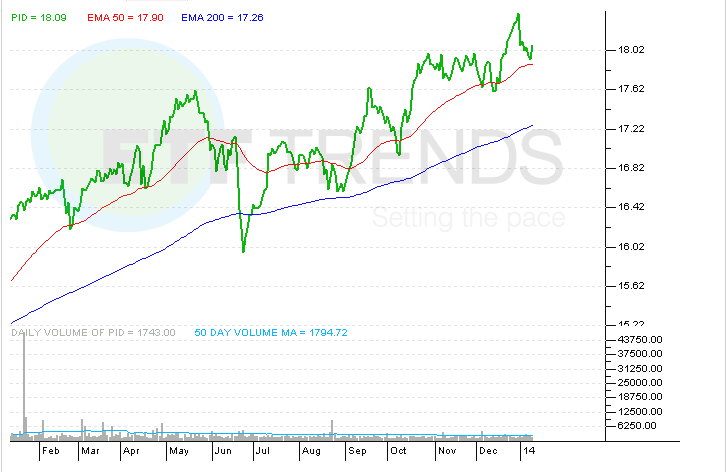
Those indices also include the NASDAQ International Dividend Achievers Index, which requires a minimum five-year dividend increase streak for admission. Investors can access that index and global dividend growth via the $1 billion PowerShares International Dividend Achievers Portfolio (NYSEArca: PID).
“PID’s portfolio is practically a ‘who’s who’ list of high-quality international stocks,” writes Charles Sizemore for InvestorPlace. “The past five years have been rough ones for the general market, to say the least. Any company that has been able to raise its dividend throughout the past five years of serial crises is one that is worth considering for investment. And PID has an entire portfolio full of them.”
PID offers ample exposure to many of the blue-chip laden sectors dividend investors favor when mining for U.S. income stocks. That is to say just as VIG has been popular with investors for holding dependable dividend raisers such as Procter & Gamble (NYSE: PG), Abbott Labs (NYSE: ABT) and Exxon Mobil (NYSE: XOM), PID meets the challenge by allocating almost half its total weight to the energy, health care and consumer staples sectors.
PID’s top-10 holdings include AstraZeneca (NYSE: AZN), Statoil (NYSE: STO) and GlaxoSmithKline (NYSE: GSK). Although the trailing 12-month yield on PID is just 2.21%, that this slightly better than the equivalent on VIG and the three aforementioned stocks boast higher dividend yields than do Exxon or Johnson & Johnson (NYSE: JNJ).
Other familiar names held by PID include Vodafone (NYSE: VOD), Unilever (NYSE: UN) and Diageo (NYSE: DEO). Noteworthy exclusions include European oil giants Royal Dutch Shell (NYSE: RDS-A), BP (NYSE: BP) and Total (NYSE: TOT).
PID does offer some twists. For example, it is not an “ex-U.S.” fund as the U.S. accounts for 21.1% of the ETF’s weight. Nor is PID a dedicated developed markets fund as Russia, India and China combine for nearly 8% of the ETF’s weight. [Global Dividend ETFs Demand Attention]
The NASDAQ International Dividend Achievers Index gained over 19% last year and is rebalanced quarterly in March, June, September and December.
PowerShares International Dividend Achievers Portfolio