U.S. stocks have been in rally mode for most of this year and looked poised to end 2013 in strong fashion. Still, the market is getting smaller on multiple fronts.
Not only are there far few companies trading in the U.S. today than were in the go-go days of the 1990s, but companies are buying back their own shares at a voracious clip. “The total number of U.S. exchange-listed companies peaked near 8,800 in 1997 and has since sunk to 4,900 as of year-end 2012,” reports Michael Santoli for Yahoo Finance, citing data from Strategas Group.
Delistings of failed technology companies following the bursting of the tech bubble, a raft of mergers and acquisitions prior to the financial crisis and several years of slack initial public offering activity are among the factors contributing to few listings, notes Santoli. Buybacks are playing a part as well and one that is benefiting some ETFs.
FactSet reports that S&P 500 companies repurchased an aggregate $415 billion the past four quarters, up 12% from a year earlier, according to Yahoo Finance. Increased buyback ETF has benefited the PowerShares Buyback Achievers Portfolio (NYSEArca: PKW), among other ETFs. Year-to-date, PKW is up 40.4% compared to a 29% gain for the S&P 500. [Buyback ETF Still Soaring Despite Tapering Chatter]
PKW is impressive on several other fronts. The ETF has surged despite not holding Apple (NadsaqGM: AAPL), one of the most voracious buyers of its own shares. Although Apple has been buying back its own shares and may do more of that if Carl Icahn gets his way, it has not yet qualified for admission into the NASDAQ US Buyback AchieversIndex, PKW’s underlying index.
The NASDAQ US Buyback Achievers Index stipulates that constituent companies have effected a net reduction in shares outstanding of 5% or more in the trailing 12 months, according to PowerShares.
Additionally, PKW has outperformed many of its top holdings this year and has hauled in over $1.8 billion in new assets just this year, making it third-best PowerShares ETF in terms of asset-gathering proficiency in 2013. [PowerShares Plans Global Version of PKW]
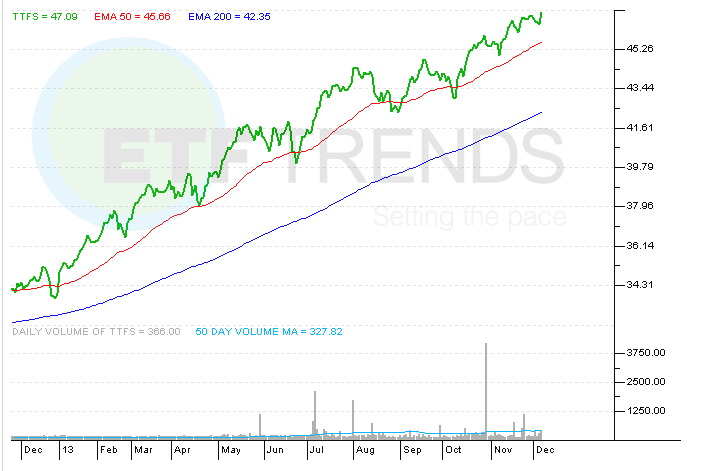
The actively managed AdvisorShares TrimTabs Float Shrink ETF (NYSEArca: TTFS) has also benefited from shrinking share counts with a 35.1% year-to-date gain. TTFS differs from PKW in that the former is an equal-weight and that its screen encompasses more than just share buybacks. TrimTabs gauges a company’s shareholder friendliness by not only its share repurchasing prowess, but if it is buying back those shares with free cash flow, not debt, and not increasing their leverage.
Another ETF that is benefiting from the shrinking market is the iShares Microcap ETF (NYSEArca: IWC). IWC tracks the Russell Microcap Index, which as Santoli notes, takes the 1,000 smallest members of the Russell 2000 and combines those stocks with the next 1,000 stocks that are smaller.
That means IWC should be home to close to 2,000 stocks, but that number was less 1,350 as of Dec. 6, according to iShares data, implying there simply are not enough credible micro-caps for inclusion in IWC. The ETF is up almost 41% this year.
TrimTabs Float Shrink ETF
Tom Lydon’s clients own shares of IWC and TTFS.