Despite calls, many unfounded, for their demise, bank loan funds continue to thrive. Through the end of October, year-to-date inflows to these products were over $54.3 billlion.
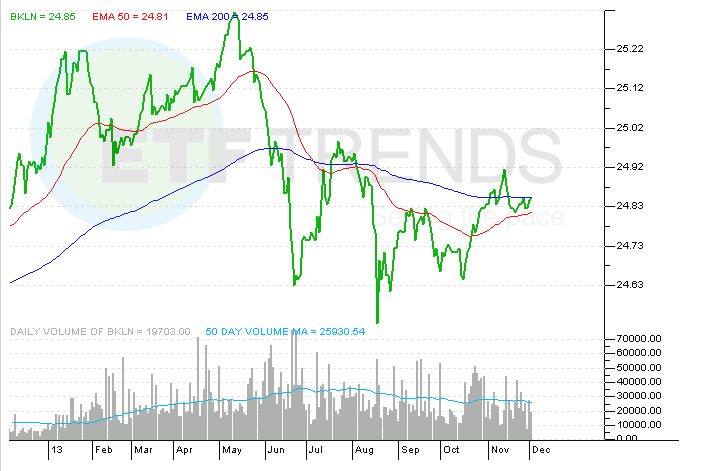
Regarding exchange traded funds, there are four bank loan ETFs. Led by the PowerShares Senior Loan Portfolio (NYSEArca: BKLN), the quartet have combined 2013 inflows of over $5.4 billion. That is an arguably impressive total when considering that as these ETFs have risen in popularity, the chorus of critics singing warning signs has grown louder.
Year-to-date, BKLN is the top asset-gatherer among PowerShares ETFs and that is saying because PowerShares is the fourth-largest U.S. ETF issuer with an expansive lineup of funds.
The allure of bank loans and the ETFs that hold them includes high yields and low sensitivity to interest rate changes. For example, BKLN has a 30-day SEC of almost 4.1%. The actively managed First Trust Senior Loan Fund (NasdaqGS: FTSL), which debuted in May and already has $121.1 million in assets, has a 30-day SEC yield of 3.24%. [More Competition in Hot Bank Loan Sector]
Still, some market observers have questioned the liquidity of the bank loan market. Others have warned that the trading rate risk for higher credit risk is not worth it because bank loans would be vulnerable in the event of a U.S. recession.
“Yes, bank-loan funds are marked with more-than-average credit risk, because they invest in below-investment-grade corporate loans. They’re comparable in credit quality to junk-bond funds, and some advisers contend that they’re even riskier. But that’s debatable,” writes John Gerard Lewis for MarketWatch.
Lewis notes that as of August, Moody’s trailing 12-month default rate on traditional junk bonds was 2.9%, but the rate was just 2.2% for the S&P/LSTA U.S. Leveraged Loan Index. The actively managed SPDR Blackstone/GSO Senior Loan ETF (NYSEArca: SRLN) seeks to beat the S&P/LSTA U.S. Leveraged Loan 100 Index. SRLN debuted in April and already has $571.1 million in assets. [Bank Loan ETFs Keep Growing]
About three-quarters of SRLN’s holdings are rated BB-, B+ or B. Eighty-six percent of BKLN’s holdings are rated BB or B. The $118.1 million Highland/iBoxx Senior Loan ETF (NYSEArca: SNLN) follows a similar path, but the fund offers a 30-day SEC yield of 4.93%.
As rates have risen, bank loan ETFs have stood tall. BKLN and SRLN are up an average of 2.5% this year while the iShares iBoxx $ Investment Grade Corporate Bond ETF (NYSEArca: LQD) is down by almost the same amount.
“Bank-loan funds regularly and frequently adapt to rate changes, they have virtually no sensitivity to rate changes. Hence, their duration is effectively zero,” according to Lewis.
One way of looking at bank loans is that they are floating rate products because the rates on the loans are reset every month or two months. By comparison, the two largest junk bond ETFs sport durations above four years.
Bank loan funds are also less correlated to stocks than are junk bonds. Over the past year, BKLN has a correlation o 0.514 to the S&P 500 compared to 0.609 for the iShares iBoxx $ High Yield Corporate Bond ETF (NYSEArca: HYG).
SPDR Blackstone/GSO Senior Loan ETF
Tom Lydon’s clients own shares of LQD and HYG.