Already among the best ex-U.S. developed market performers this year, exchange traded funds that track Japan are coming off some scorching performances in November that could set the high-flying ETFs up for further upside heading into year-end.
Last month, the WisdomTree Japan Hedged Equity Fund (NYSEArca: DXJ), the top asset-gathering ETF this year, jumped 6% while its rival for yen-hedged supremacy, the db X-trackers MSCI Japan Hedged Equity Fund (NYSEArca: DBJP) rallied by roughly the same amount. The unhedged iShares MSCI Japan ETF (NYSEArca: EWJ), which trails DXJ for top honors in asset-gathering proficiency, rose more than 2% in November. [The Japan ETF Breakout Everyone has Been Waiting For]
Japan ETFs were, of course, led by Japanese stocks as the benchmark Nikkei 225 surged 9.3% last month, posting its best November performance since 2005. After months of lethargic action, which gave rise to concern about the yen possibly strengthening in earnest against the dollar, the Japanese currency has again given bears reason to cheer and there is evidence that Abenomics is working. [An Epic Move for Japan ETFs Could be Near]
Data released on Friday “showed Japanese consumer inflation accelerated to a five-year high and factory output rose for a second straight month in October, more evidence the recovery in the world’s third-largest economy should extend into 2014,” according to Reuters.
Up 51% this year, the Nikkei could remain flat for the rest of 2013 and still cruise to its best annual performance since 1972, Reuters reported.
Last year, Japanese stocks and the corresponding ETFs listed in the U.S. rallied late in the year, but that was because of an obvious catalyst: The election of Prime Minister Shinzo Abe.
The rise in Japanese equities coupled with the faltering yen come as futures traders have pushed their net short yen bets to the highest levels in over six years, a sign that some market observers believe Abe and the Bank of Japan will be successful in engineering 2% inflation. [Hedge Funds see More Downside for Yen]
Last month, Daiwa said the Japanese economy, the world’s third-largest, is inching towards a virtuous cycle while Nomura forecast the Nikkei to hit 16,000 by the end of next March and 18,000 by the end of 2014. Goldman Sachs chimed in with an overweight rating on Japanese stocks. [A 2014 Sequel for Japan ETFs?]
In late November, Goldman said it expects Japan broader Topix to reach 1,450 next, about 15% upside from current levels.
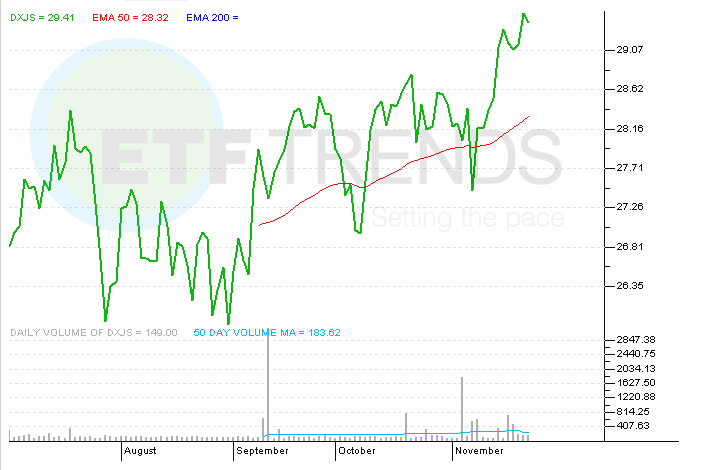
Given the expected upside going forward for Japan ETFs, investors may also want to consider mixing in some small-cap exposure to complement a fund such as DXJ or DBJP. The WisdomTree Japan Hedged Small Cap Fund (NasdaqGS: DXJS), DXJ’s small-cap equivalent, jumped 4.3%. Although DXJS is a currency-hedged play, it is designed to be a play on a recovery in Japan’s domestic economy. The fund has accumulated nearly $32 million in assets since its late June debut. The SPDR Russell/Nomura Small Cap Japan ETF (NYSEArca: JSC) is up 11% in the past 90 days.
WisdomTree Japan Hedged Small Cap Fund
Tom Lydon’s clients own shares of DXJ.