The SPDR Gold Shares (NYSEArca: GLD) is a week away from its ninth anniversary, one that will be marked by SPDR Gold Shares and the World Gold Council ringing the closing bell at the New York Stock Exchange Tuesday.
GLD, the oldest and largest ETF backed by physical holdings of gold, celebrates this anniversary at a time when gold, barring a miracle, will finish with its first annual loss in the past 13 years. The ETF is by far the worst in terms of year-to-date outflows, having hemorrhaged $22.2 billion in assets. To be fair, the iShares Gold Trust (NYSEArca: IAU) is also on the list of 10 worst ETFs in terms of 2013 outflows. [Gold ETFs Can’t Wait for October to End]
There are glimmers of hope for GLD, IAU and other ETFs backed by physical bullion. After investors continued pulling cash from gold ETFs last month despite decent performances, gold funds saw incremental inflows last week. [Gold ETFs Finally See Inflows]
However, demand for physical gold in the U.S. is tepid.
“The number of one-ounce gold coins (the primary bullion product offering) hit 35,333 on a rolling 6-month basis in October, which was the least since July 2008. The 12-month rolling average wasn’t so dismal; by that measure 70,708 one-ounce coins were sold in October, which was the least since this past March. For the sake of comparison, peak sales during the Great Recession were 130,083 (April 2009) and 114,125 (November 2009) for the respective 6-month and 12-month rolling averages. Currently, gold sales are down 73% and 38%, respectively, from those peaks,” according to ConvergEx Group Chief Market Strategist Nick Colas.
On the other hand, Colas notes there is some supportive anecdotal evidence that could hearten gold bulls, evidence acquired in conversations with dealers in New York’s famed Diamond District.
“However, most dealers think now is a good time to buy, since gold is relatively cheap. Their argument is simple: You want to buy in a pullback (when no one else wants to buy) that is certain to be relatively short-lived. Right now, the price of gold is hovering just above $1,300 an ounce, which is on par with levels from the latter half of 2010 and a good 25% below its peak. For the first time since the turn of the century, gold is on pace to suffer a calendar-year loss, though it does seem sure to rebound, according to our bullish interviewees. Gold doesn’t display the “panicky” characteristics typically associated with bubbles, so they’re betting its relatively low price will become attractive to investors, rather than a sign the yellow metal’s reign is over,” writes Colas.
Silver ETFs such as the iShares Silver Trust (NYSEArca: SLV) and the ETFS Physical Silver Shares (NYSEArca: SIVR) could be better bets than their gold counterparts. Silver ETFs have been outpacing their gold rivals in recent months by noticeable margins and demand is picking up in India following a new tariff on gold imports implemented by that country in an effort to stem a widening current account deficit.
“Turning to silver, people in India are now going to purchase silver for the same purpose as they bought gold in the past. India is the world’s largest consumer of both gold and silver, though Indians purchased only about half the gold they usually buy in the lead up to Diwali this year. Diwali is typically the biggest gold-buying occasion in India, though a 10% import tax imposed by the Indian government has pushed the premium in India to $100-$103 a troy ounce above the international market. A year ago the premium was just $2-$3, while in January 2012 the import tax was just 2%. According to Reuters, demand to buy silver in India through October of this year is already double that of full-year 2012. Dealers on 47th Street expected this trend will continue for the foreseeable future,” according to Colas. [Silver ETFs Could Rally]
Although nearly $24.3 billion has been pulled from GLD and IAU combined this year, SLV has 2013 inflows of almost $386.5 million.
Monthly Sales of Gold & Silver Coins
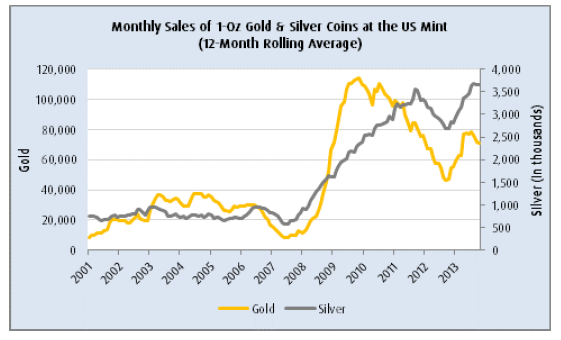
Chart Courtesy: ConvergEx Group
ETF Trends editorial team contributed to this post. Tom Lydon’s clients own shares of GLD and SLV.